Before choosing a test, ask the client what evidence would help them decide: a work sample, a coding exercise or an assessment of a particular behavior. Agree how they will use the result and how much time candidates should spend on it. Vendor details were checked October 16, 2026; the options below are starting points for evaluation, not comparative test winners.
Quick picks by assessment need
Scroll the table to see all columns →
| Need | Starting options | Check first |
|---|---|---|
| General role skills | TestGorilla, Criteria, Vervoe | Relevant tasks, completion time and candidate accommodations |
| Coding | CodeSignal, CoderPad, Codility | Realistic work, permitted AI use and the candidate’s time |
| Cognitive or personality | SHL, Hogan, The Predictive Index | Validation for the role and how results inform a human decision |
| One-way video | Spark Hire, Willo, Hireflix | Accessibility and whether any AI scoring is involved |
| Staffing at volume | Glider AI, Harver | Client workflow, consent and the integrations you actually need |
Shortlist by the task you need to assess, then pilot the test with your client before relying on its scores.
Start with the question, then pick the test
Start with the uncertainty you need the assessment to resolve. Clients often ask for “a test” when they mean “I’m not sure this person can actually do the job.” Find out which doubt they have before you choose anything.
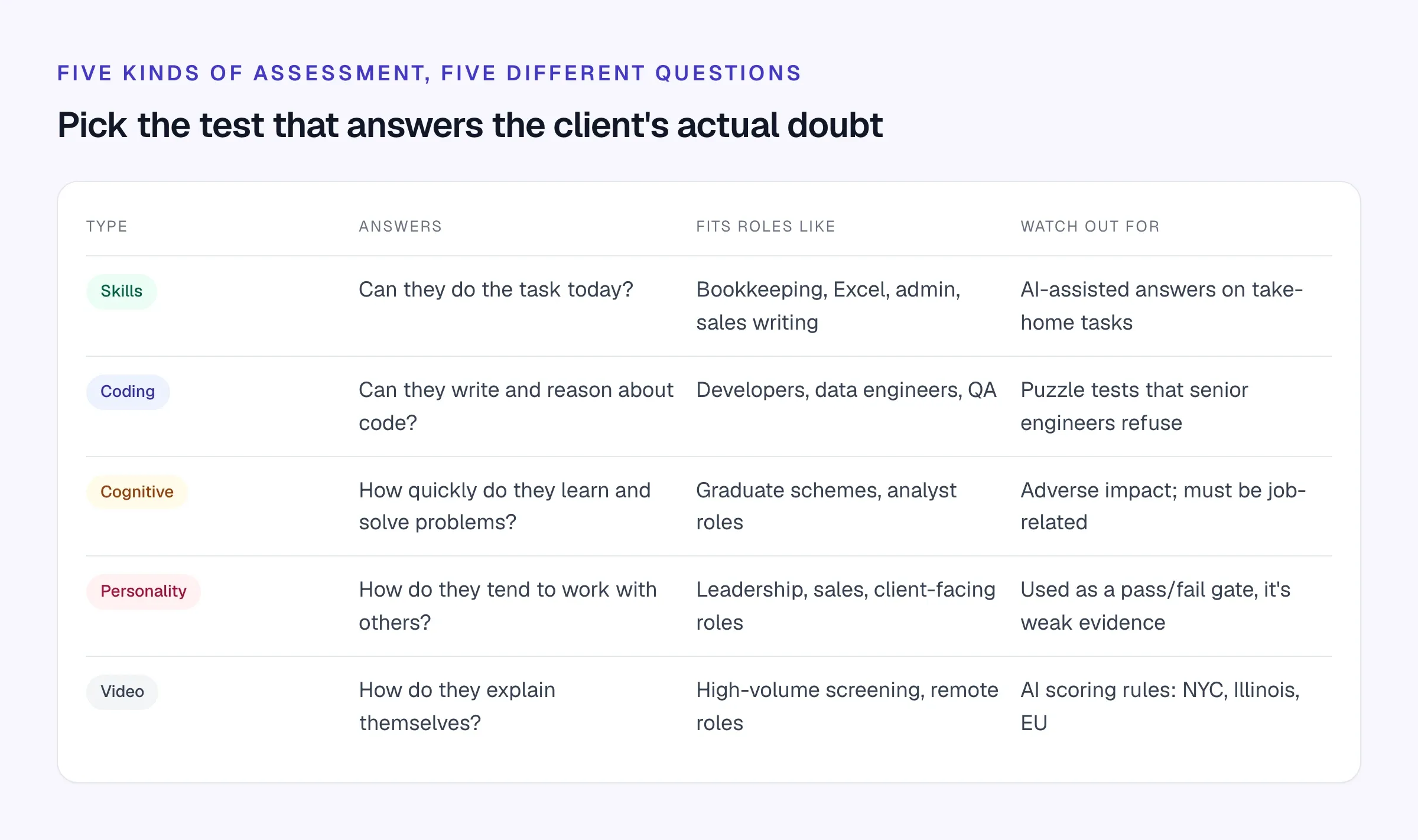
A useful rule: if the job has a task you can simulate in 20 minutes, a work-sample or skills test beats anything else. Cognitive and personality measures are better as one input among several, especially for senior and client-facing roles.
How agencies should use assessments with clients
Agencies sit between two parties who both have to trust the test. The candidate needs to believe it’s fair and worth their time. The client needs to believe the result means something. Agree the purpose and interpretation with the client before asking the candidate to take it.
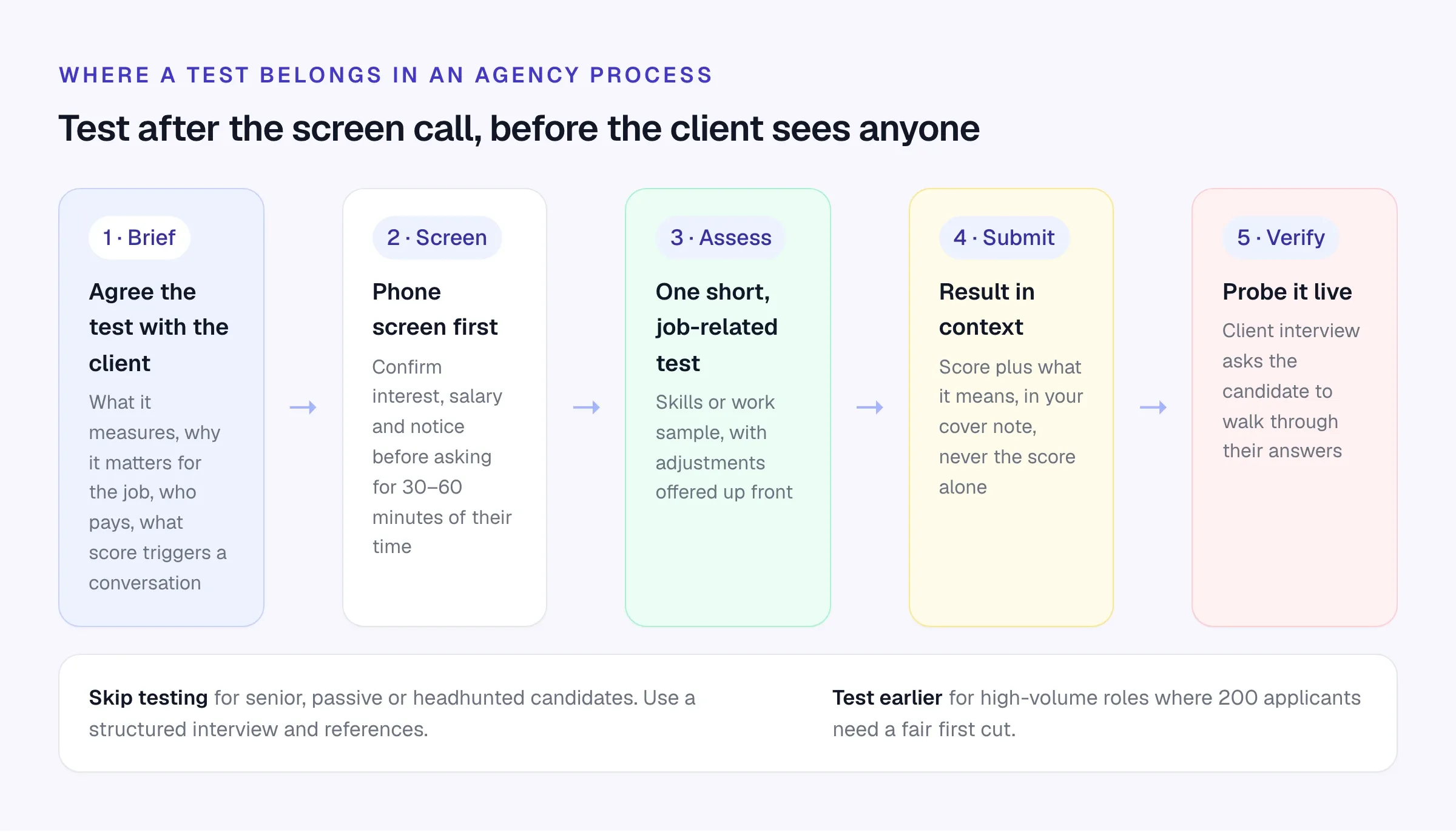
- Agree the test in the brief. What does it measure, why does that matter for this job, who pays, who owns the account, and what score prompts a conversation rather than an automatic rejection. Write it into the job notes.
- Screen by phone first. Don’t send a test to someone who hasn’t confirmed salary, location and interest. It wastes their time and inflates your drop-off. Testing is a filter on a shortlist you’ve already sourced and qualified, not a substitute for it.
- Tell candidates what to expect. How long, what format, whether AI tools are allowed, and how to request adjustments. Give those details before the candidate commits time to the test.
- Keep it short. Twenty to forty minutes is plenty for most roles. Passive and senior candidates won’t do more before they’ve met the client.
- Submit the result in context. Put a one-line interpretation in your cover note, not a screenshot of the score. “Scored in the top quarter on the Excel test; strongest on lookups and pivot tables, slower on macros, which the role uses lightly” is useful. “78%” isn’t.
- Close the loop with a live check. Suggest the client ask the candidate to walk through two answers at interview. It’s the best defence against AI-assisted answers and it gives the interview a concrete starting point.
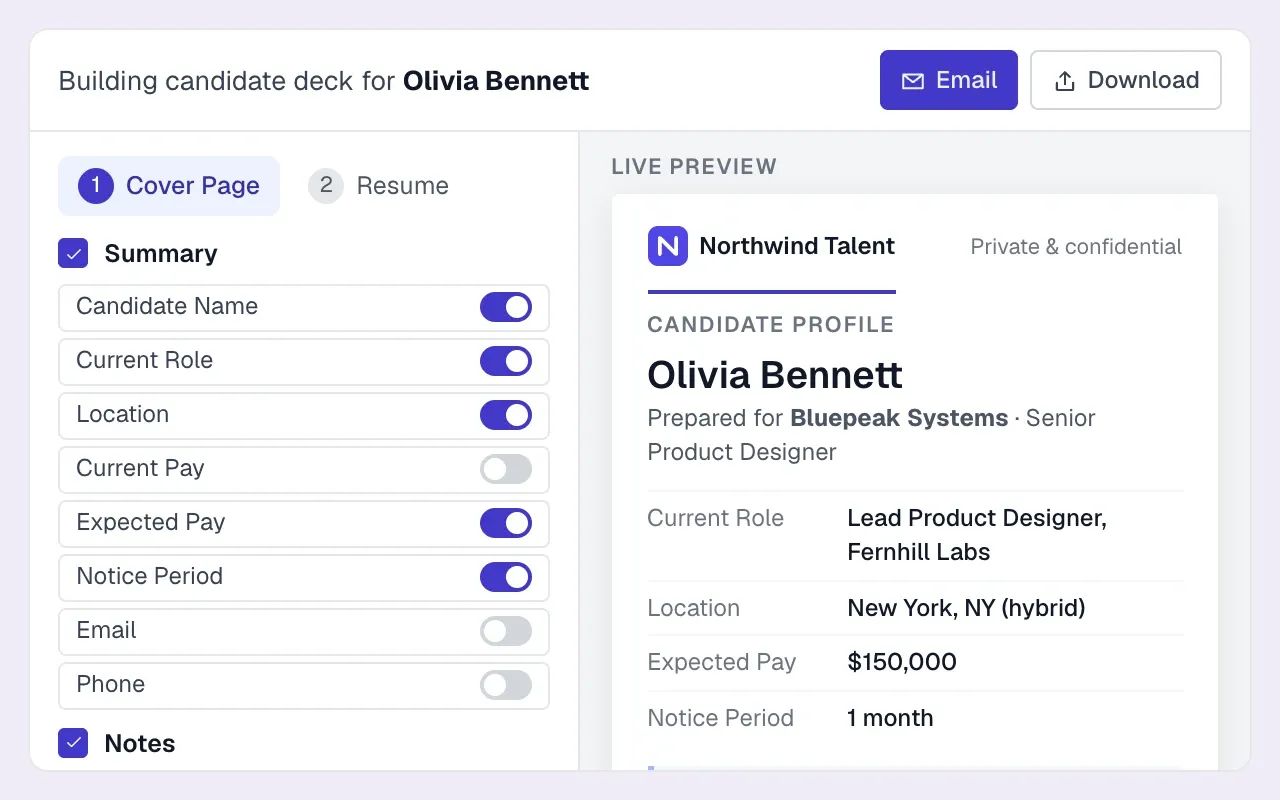
In Longlist, the CV pack cover page lets you choose and edit the summary fields and add your recommendation, which is where a short assessment interpretation belongs. Our candidate submission template shows how to structure the rest of the note.
Skills and multi-test platforms
These platforms bundle a library of skills, cognitive and personality tests with an applicant-friendly testing experience. They’re the natural starting point for agencies working across several role types.
TestGorilla
Website ↗- Best for
- Agencies testing a wide mix of roles; easiest free start
- Pricing
- Free plan (10 credits/month); Core from $215/month and Plus from $520/month, billed annually (October 2026)
A large library of skills, cognitive and personality tests. The Plus plan adds AI interviews, job simulations, video questions and coding tests. Anti-cheating features include webcam snapshots, full-screen mode, copy-paste blocking and location logging; ID verification and ATS integrations are on Plus only.
For agencies: the free plan is enough to trial a test on one live role and see whether candidates complete it.
Criteria
Website ↗- Best for
- Validated cognitive, personality and skills tests with interviewing in one platform
- Pricing
- Quote-based; 14-day free trial
Criteria (Criteria Corp) sells cognitive aptitude, personality, emotional intelligence and skills tests alongside video interviewing and, since May 2025, AI interview scoring. AI proctoring is an add-on. Majority-owned by Sumeru Equity Partners since 2019.
Vervoe
Website ↗- Best for
- Job simulations that look like the real work
- Pricing
- Quote-based
Vervoe builds skills tests and job simulations with AI grading, and advertises generative-AI detection. Good when a client wants to see candidates do something resembling the job, such as answering a customer email or building a small spreadsheet model.
Canditech
Website ↗- Best for
- Small teams wanting simulations and anti-cheating at a published price
- Pricing
- Team $150/month, Pro $200/month, billed yearly; free start
Skills tests and job simulations with “monitored ChatGPT” (letting candidates use AI while you see how they use it) and webcam snapshots. Lists 40+ ATS integrations.
Testlify
Website ↗- Best for
- Low-cost entry with a short trial
- Pricing
- Standard $139/month or $1,668/year; 7-day trial
A broad skills-test library on a credit model, with live video proctoring as a paid add-on per attempt. Check the ATS integration terms carefully: the pricing page lists integrations as an add-on on the Standard plan.
Adaface
Website ↗- Best for
- Staffing firms that want a predictable annual credit bundle
- Pricing
- From $500/year (Starter, 50 credits); Unlimited staffing plan $50,000/year; annual billing only
Chat-style skills and coding assessments sold as annual credit bundles, from an Individual plan at $180 a year up to Enterprise and a dedicated unlimited plan for staffing firms. 14-day trial.
Alooba
Website ↗- Best for
- Data, analytics and finance roles
- Pricing
- Lite from $250/month; Professional from $575/month
Strongest for analytical roles. Proctoring and ATS integrations (Greenhouse, Lever, Workable, SmartRecruiters) start on the Professional plan.
Coding assessments
For developer roles, the format matters as much as the vendor. Senior engineers often refuse algorithm puzzles; a realistic take-home or pair-programming session in a shared editor gets more completions and better signal.
CodeSignal
Website ↗- Best for
- Tech agencies wanting proctored tests at a published self-serve price
- Pricing
- Build $79/month (annual) or $99 (monthly); Grow $479/month (annual) or $599 (monthly)
AI proctoring and ID verification are on every plan. CodeSignal also offers “agentic” assessments where candidates work with AI coding tools, and AI interviewers. Its own data shows cheating attempts on proctored tests more than doubled in 2025.
CoderPad
Website ↗- Best for
- Live pair-programming interviews and realistic take-homes
- Pricing
- Starter $80/month (annual) or $120 (monthly); Team $400/month (annual) or $500 (monthly)
Best known for its collaborative live-coding editor; it also owns CodinGame for screening tests. Free trial with no card. Code playback is on every plan, which helps when a client asks how a candidate reached an answer.
Codility
Website ↗- Best for
- Structured coding tests for teams hiring engineers steadily
- Pricing
- Starter $1,200/year (120 invites); Scale $600/month or $6,000/year (300 invites)
Coding tests and interviews. The custom tier adds video proctoring, ID verification and a desktop app designed to detect hidden AI helper apps.
HackerRank
Website ↗- Best for
- Clients that already use HackerRank or want certified tests
Coding tests, live interviews and certified assessments, with AI plagiarism detection that flags likely ChatGPT use and integrations with Greenhouse, Workday, iCIMS, Lever and SmartRecruiters. We couldn’t load current list prices from HackerRank’s pricing page in October 2026; a free account is available to start.
Cognitive and personality assessments
These measure how someone thinks and tends to behave rather than what they can do today. They’re most useful for leadership, sales and graduate roles, and they carry the most legal risk if used as a hard cut-off.
The Predictive Index
Website ↗- Best for
- Clients that already run PI internally and want comparable profiles
- Pricing
- Plans start at $10,000/year
Behavioral and cognitive assessments with team and job-fit tools and 97+ integrations. For agencies, PI is most useful when the client is already a PI customer and wants your shortlist profiled the same way.
SHL
Website ↗- Best for
- Large clients and graduate programs needing established psychometrics
- Pricing
- Quote-based
Long-established psychometric publisher: OPQ personality questionnaire, Verify cognitive ability tests, simulations and Smart Interview video.
Hogan Assessments
Website ↗- Best for
- Executive and leadership assessment
- Pricing
- Quote-based; sold via certified practitioners and partners
Personality assessments covering everyday strengths, derailers under pressure and values. Results are normally interpreted by a Hogan-certified practitioner, which suits executive search firms with a certified consultant.
Thomas International
Website ↗- Best for
- UK SMEs wanting behavioral profiles across hiring and development
- Pricing
- Per employee per month; Expert plan on application
Behavioral, aptitude and emotional intelligence assessments on Team, Professional and Expert plans. A familiar name with UK clients.
Bryq
Website ↗- Best for
- Small teams wanting cognitive plus personality at a low published price
- Pricing
- Pro $69/month ($828/year on an annual commitment)
Combines cognitive and personality measures into a job-fit view, with self-serve integrations for Workable, Greenhouse, Lever and Ashby.
Arctic Shores
Website ↗- Best for
- UK graduate and early-careers volume
- Pricing
- Quote-based
UK task-based psychometrics: candidates complete interactive tasks rather than text questions. Arctic Shores claims its tasks can’t be completed by generative AI tools the way text-based tests can, which is a vendor claim worth testing with your own pilot.
One-way video and AI interviews
Video tools let candidates record answers to set questions on their own time. They save scheduling effort for high-volume roles. They also attract the most regulation when AI scores the answers.
Spark Hire
Website ↗- Best for
- US agencies adding one-way video to a screening process
- Pricing
- Video interviews from $249/month (annual) or $299 (monthly)
One-way and live video interviews, plus a behavioral assessment from its 2023 acquisition of Chally, at the same price. 50+ ATS integrations.
Willo
Website ↗- Best for
- UK agencies paying per live role
- Pricing
- Lite £49 per live role per month, no contract; Enterprise from £2,999/year
UK-based one-way video interviewing. The per-role pricing suits agencies whose volumes swing month to month.
Hireflix
Website ↗- Best for
- Simple one-way video on a small budget
- Pricing
- Small $75/month, Medium $150/month, billed yearly; 1-month free trial
Straightforward one-way video interviews. Its custom plan lists recruitment agencies as a use case.
HireVue
Website ↗- Best for
- Enterprise clients with high-volume programs
- Pricing
- Quote-based
Enterprise video interviewing and assessments. HireVue acquired Modern Hire in 2023. If a client asks you to put candidates through HireVue, it will normally be on the client’s account and under the client’s process.
Built for staffing and high volume
Glider AI
Website ↗- Best for
- Staffing firms and MSP programs testing at volume
- Pricing
- Quote-based
Skills tests, coding, video interviews and AI screening aimed squarely at staffing firms, with integrations including Bullhorn, JobDiva, Beeline and Magnit. Findem agreed to acquire Glider in March 2026; check the roadmap and contract terms if you’re signing a multi-year deal.
Harver
Website ↗- Best for
- Enterprise volume hiring: retail, contact centers, logistics
Harver combines game-based assessments from pymetrics, Outmatch’s assessments, video interviewing and Checkster reference checks. Its about page says it has also acquired Symphony Talent. Mostly bought by large employers rather than agencies, but you’ll meet it on enterprise accounts.
For broader high-volume tactics beyond testing, see our guide to high-volume recruiting strategies and tools, and our job boards guide for where those applicants come from.
Fairness and the law
This section is general information, not legal advice. Agencies are covered by these rules too: US Title VII applies to employment agencies, and the UK Equality Act 2010 covers employment service-providers.
United States
- Job-relatedness. The EEOC’s guidance on employment tests and selection procedures says a test that disproportionately excludes people of a protected group must be job-related and consistent with business necessity.
- The four-fifths rule. Under the Uniform Guidelines, a selection rate for any group below 80% of the highest group’s rate is generally treated as evidence of adverse impact (29 CFR 1607.4(D)). If 50% of one group passes and 30% of another, 30 ÷ 50 = 60%, below the 80% line.
- Disability. The ADA requires reasonable accommodations in how tests are given, such as extra time or an accessible format (42 USC 12112).
- AI-scored tools. New York City’s Local Law 144 requires a bias audit within a year before use, a published summary and candidate notice at least 10 business days in advance. Illinois regulates AI analysis of video interviews and, from January 1, 2026, AI use that leads to discrimination under its Human Rights Act (Public Act 103-0804). California’s Civil Rights Council rules on automated-decision systems took effect October 1, 2025. Colorado replaced its 2024 AI Act with SB26-189, whose main employment obligations start January 1, 2027.
The EEOC withdrew its AI-specific technical assistance in early 2025, but the underlying laws on discrimination and accommodation haven’t changed.
United Kingdom and EU
- Indirect discrimination. A test applied to everyone can still be unlawful if it puts a group with a protected characteristic at a particular disadvantage and isn’t a proportionate means of achieving a legitimate aim (Equality Act 2010, s.19).
- Reasonable adjustments. Employers and service providers must make reasonable adjustments for disabled candidates, such as extra time or an alternative format (s.20).
- Automated decisions. Under the Data (Use and Access) Act 2025, new UK GDPR rules on automated decision-making came into force in February 2026 (SI 2026/82). Significant automated decisions are allowed with safeguards: telling the candidate, offering human review and letting them contest the decision.
- EU AI Act. AI used for recruitment and selection is high-risk under Annex III. After the 2026 Digital Omnibus, those obligations apply from December 2, 2027. Emotion recognition in the workplace has been banned since February 2025 (Article 5), which matters for any video tool that claims to read candidates’ emotions.
- The test measures something in the job description, and you can say why it matters
- The same test is used for every candidate on the same role
- Candidates are told the format and length, and how to ask for adjustments
- No score is used as an automatic rejection without human review
- You check pass rates across groups when volumes allow
- AI-scored tools have a bias audit or equivalent evidence from the vendor
- Candidates are told when AI is used to score them, where the law requires it
- Results are stored with the candidate record and deleted on your normal retention schedule
AI cheating: what’s changed and what to do
Assessments that worked in 2022 are easier to game now. Vendors’ own data shows it: CodeSignal reported cheating or fraud attempts on proctored tests rose from 16% in 2024 to 35% in 2025, and 40% for entry-level roles (CodeSignal). In TestGorilla’s 2025 survey, 17% of job seekers who’d taken a skills test admitted cheating, and seven in ten of those used AI (TestGorilla). Tools built to help candidates during interviews have raised venture funding (TechCrunch, June 2025).
What helps
- Short, realistic work samples instead of trivia
- Proctoring proportionate to the role
- Letting candidates use AI openly and assessing how they use it
- A live follow-up where they explain two answers
- Identity checks at interview for remote roles
What doesn’t
- Longer tests with more questions
- Treating a high score as proof on its own
- Heavy surveillance for a junior admin role
- Banning AI and assuming candidates complied
- Skipping the reference call because “they tested well”
Build a short discussion of the candidate’s work into the client interview, so the interviewer can probe how they reached an answer.
- 76% of employers surveyed used skills tests in 2025 (vendor survey of 1,084 UK and US employers, TestGorilla, 2025)
- 35% of proctored assessments saw cheating or fraud attempts in 2025, up from 16% in 2024 (vendor data, CodeSignal, February 2026)
- 1 in 4 candidate profiles worldwide could be fake by 2028, Gartner predicts (HR Dive, July 2025)
Choosing a tool: a short buying checklist
- Your top three role types. Pick the tool that tests those well. Ignore the other 300 tests in the library.
- Candidate experience. Take the test yourself on a phone. If it’s tedious for you, it’s worse for a candidate with a day job.
- Pricing model. Per-candidate credits suit irregular volumes; subscriptions suit steady ones. Agencies with uneven months should avoid annual minimums they won’t use.
- Anti-cheating features on the plan you’ll actually buy, not just the top tier.
- Bias evidence. Ask the vendor for adverse-impact data and, for AI scoring, its bias audit.
- Data handling. Where results are stored, for how long, and how you delete them when a candidate asks.
- Getting results into your workflow. Most assessment tools integrate with in-house ATSs rather than agency CRMs, so plan to attach the result PDF or a summary to the candidate record in your applicant tracking system and to your submission.
Assessments are one part of a wider stack. Our guide to the recruitment tech stack shows where they fit, and recruitment CRM vs ATS explains which system should hold the candidate record.
Present every shortlist the same way
Put the assessment result where the client reads it. Build a branded CV pack with a cover page you control, add your recommendation, and email it from Longlist. Included on every plan.