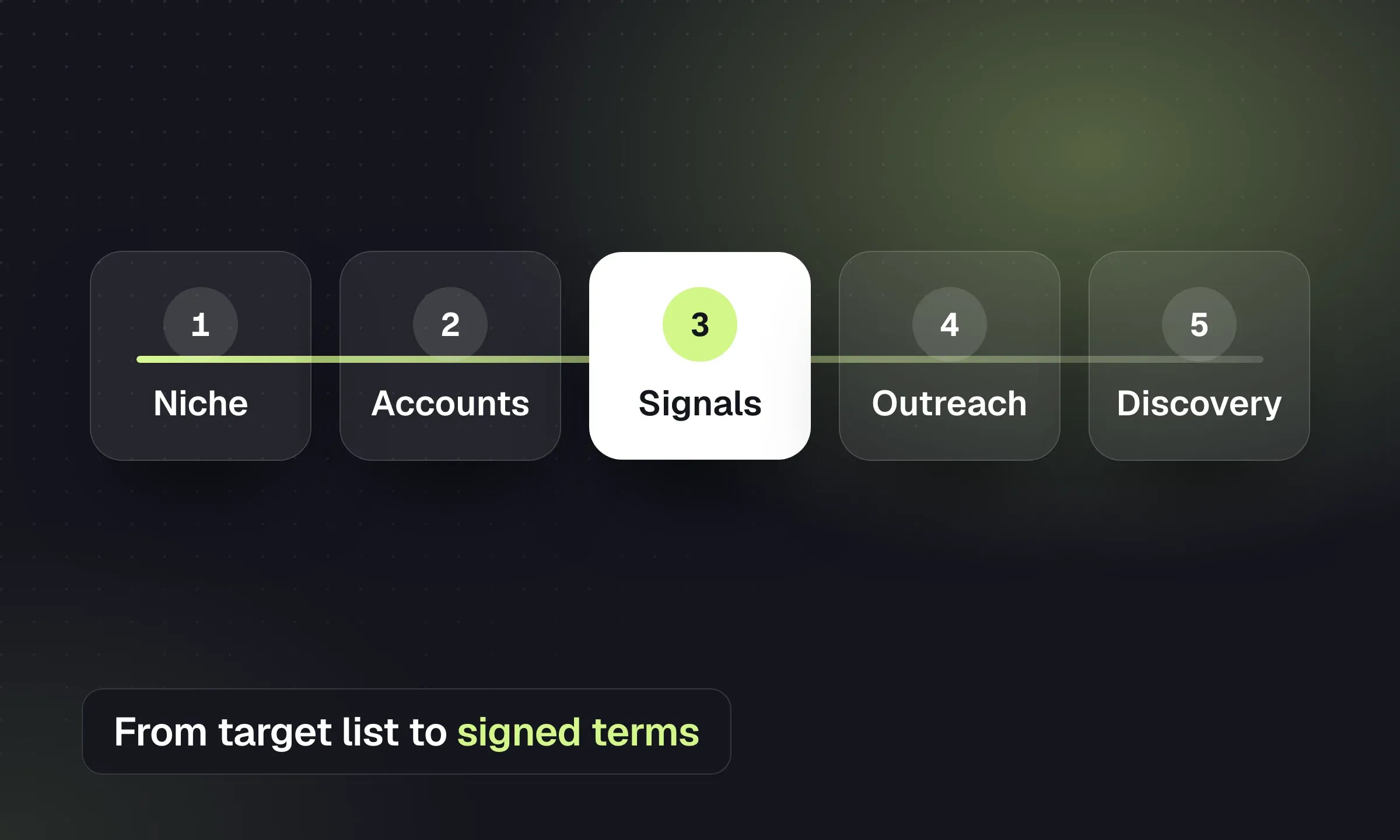
Start with companies that hire the people you know how to place. Find a hiring manager and a specific reason to call, qualify the vacancy, then agree terms before sending a CV. Delivering that first brief well gives you a reason to ask for the next one. The examples use a fictional agency placing finance professionals with manufacturers around Leeds; adapt them to your own market.
Target account list templateA CSV with columns for tier, signal, signal source, fit and access scores, contacts, owner and next action, plus two fictional example rows.Download1. Pick a niche you can actually deliver
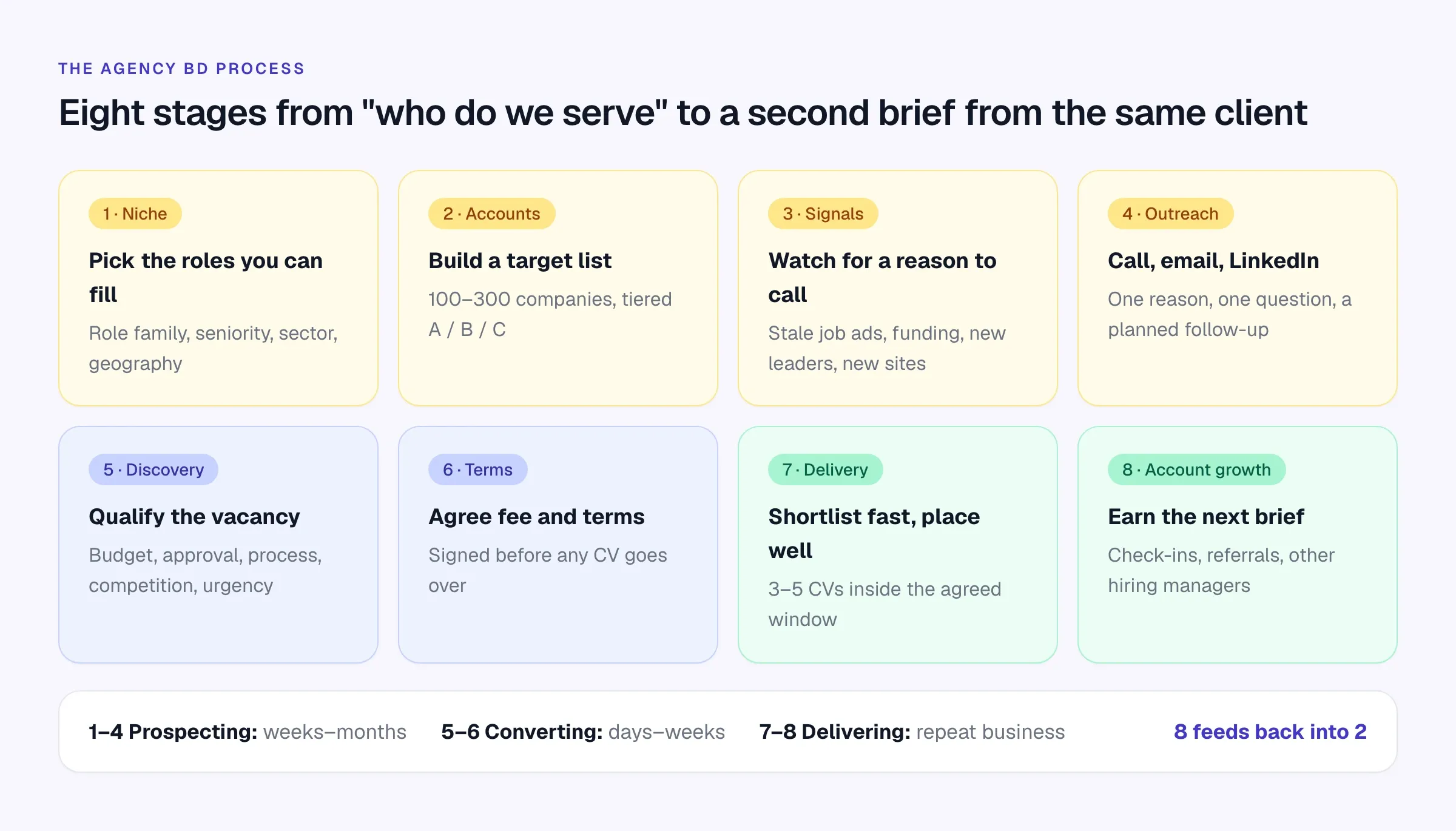
“We recruit anyone for anyone” gives a hiring manager no reason to pick you over the four other agencies in their inbox. A niche gives you three things a generalist lacks: candidates you can call today, salary and market knowledge you can quote, and a short list of companies that genuinely need you.
Run three quick tests before you commit to a market:
- Candidate test. Can you name 30 to 50 people you could call this week who would take your call about a move?
- Client test. Can you list 100 companies that hire those people at least once a year?
- Knowledge test. Could you tell a hiring manager the going salary, notice periods and the two skills that are hardest to find right now?
If you fail the first test, you will win briefs you can’t fill. If you fail the second, the market is too small to keep a desk busy.
Define the niche on five dimensions and write it down:
Scroll the table to see all columns →
| Dimension | Too broad | Workable |
|---|---|---|
| Role family | Finance | Finance managers, controllers, management accountants |
| Seniority | All levels | Mid to senior, roughly £45k–£85k |
| Sector | Any | Manufacturing and food production |
| Geography | UK | Within 50 miles of Leeds, plus hybrid roles |
| Engagement | Whatever comes in | Contingent perm, with retained for senior hires |
The engagement type also changes how you sell. A contract desk wins repeat business through rate, speed and redeployment, so its BD looks different (see contract recruitment software for how those desks run). A retained executive search firm sells a process and is paid in stages; the retained search workflow covers that model in detail. Pick the engagement type you want to sell before you write a single email.
Turn the niche into a one-line positioning statement your whole team can say on the phone. The agency marketing and sales playbook has a formula and examples.
2. Build a target account list, then tier it
A target account list is the 100 to 300 companies your desk will deliberately work over the next quarter. It is not your whole CRM and it is not every company with a live job ad.
Where the companies come from
Start with what you already own, then add research:
- Your own records. Past clients, companies where you placed candidates, and companies your candidates have worked for. Your recruitment CRM usually holds more warm accounts than anyone has looked at.
- Job boards and careers pages. Who is advertising the roles you place, and who keeps advertising them?
- LinkedIn and Sales Navigator. Filter companies by industry, headcount and location, then by recent hiring or headcount growth.
- Public filings. Companies House in the UK and SEC filings (including Form D notices of private fundraising) in the US show new entities, accounts and fundraising.
- Industry sources. Trade association member lists, trade show exhibitor lists, regional “fastest-growing” lists and local business press.
Who to contact inside each account
Map three or four people per company, not one:
- The hiring manager for your role family. They feel the vacancy and can describe what good looks like.
- Their manager. Useful for senior roles and when the hiring manager has gone quiet.
- Talent acquisition or HR. In larger companies they control the preferred supplier list (PSL). Treat them as a partner, not an obstacle to route around.
- A peer in an adjacent team who may hire similar profiles.
Tier the list so your time goes to the right accounts
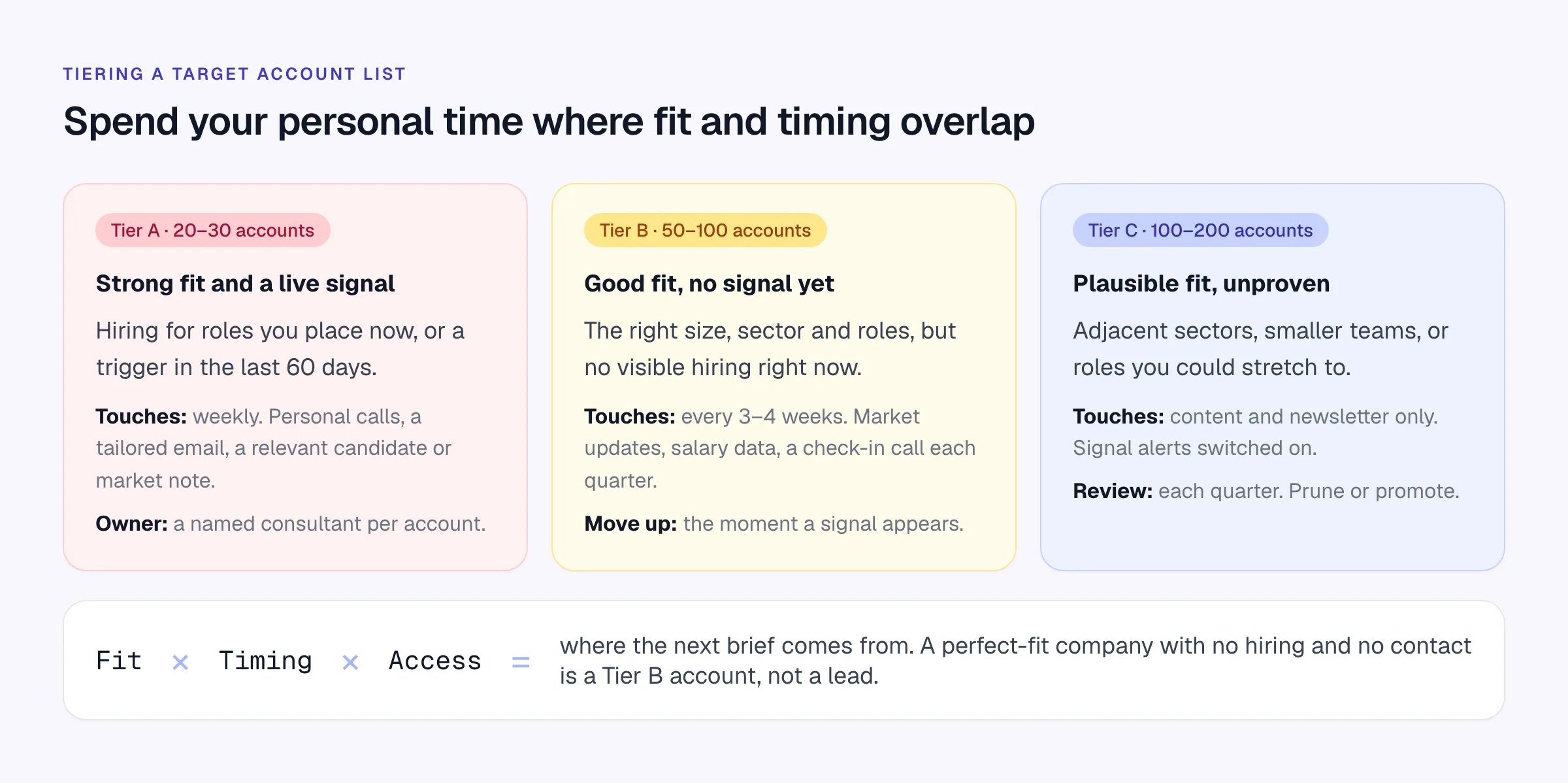
Tier A gets your phone time. Tier B gets a useful touch every few weeks so you are remembered when they do hire. Tier C gets content and automated alerts until something changes. Review the tiers monthly; an account should move up the day a signal appears.
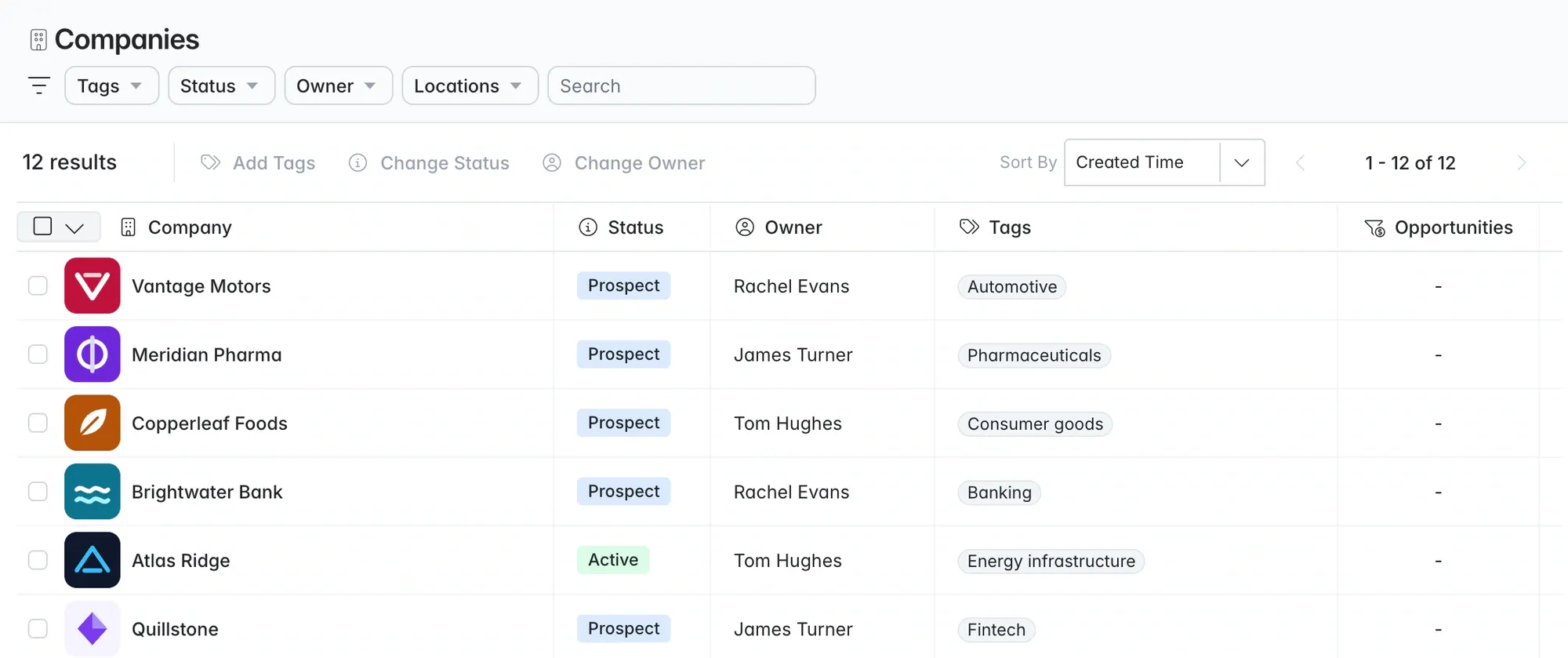
3. Watch for a reason to call
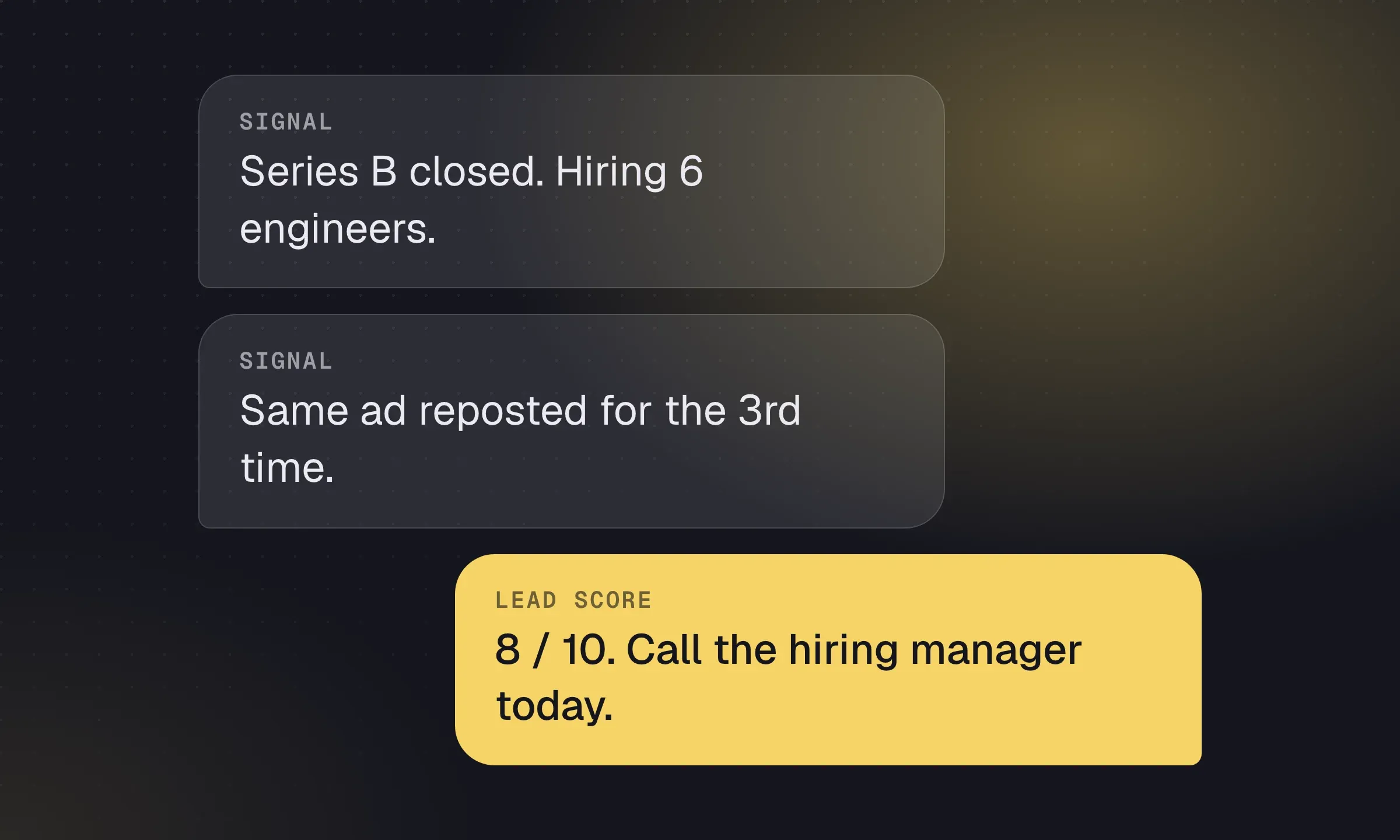
Fit tells you who could become a client. Timing tells you who might become one this month. A hiring signal is a public, checkable event that suggests a company is about to hire, or is struggling to.
Scroll the table to see all columns →
| Signal | What it may mean | A fair opening line |
|---|---|---|
| Same role advertised for 30+ days, or re-posted | Direct hiring isn’t working | “I noticed the controller role has been open a while. How’s the search going?” |
| Several similar roles at once | Team build-out or attrition | “Three finance roles at once usually means a new structure. What’s changing?” |
| New finance director or CFO | New leaders often reshape their team | “Congratulations on the role. Are you planning changes to the team?” |
| Funding round, acquisition or new site | Budget for headcount | “With the new Wakefield site, who’s leading finance there?” |
| A key person leaves | Backfill needed, possibly urgently | Lead with market knowledge, never with gossip. |
Record the source and date of every signal. A job ad is context for a conversation, not proof that the company wants an agency. If you mention it, be accurate.
The recruitment lead generation guide goes deeper on signal sources, alerts and how to score a lead before you spend time on it.
4. Run multi-channel outreach
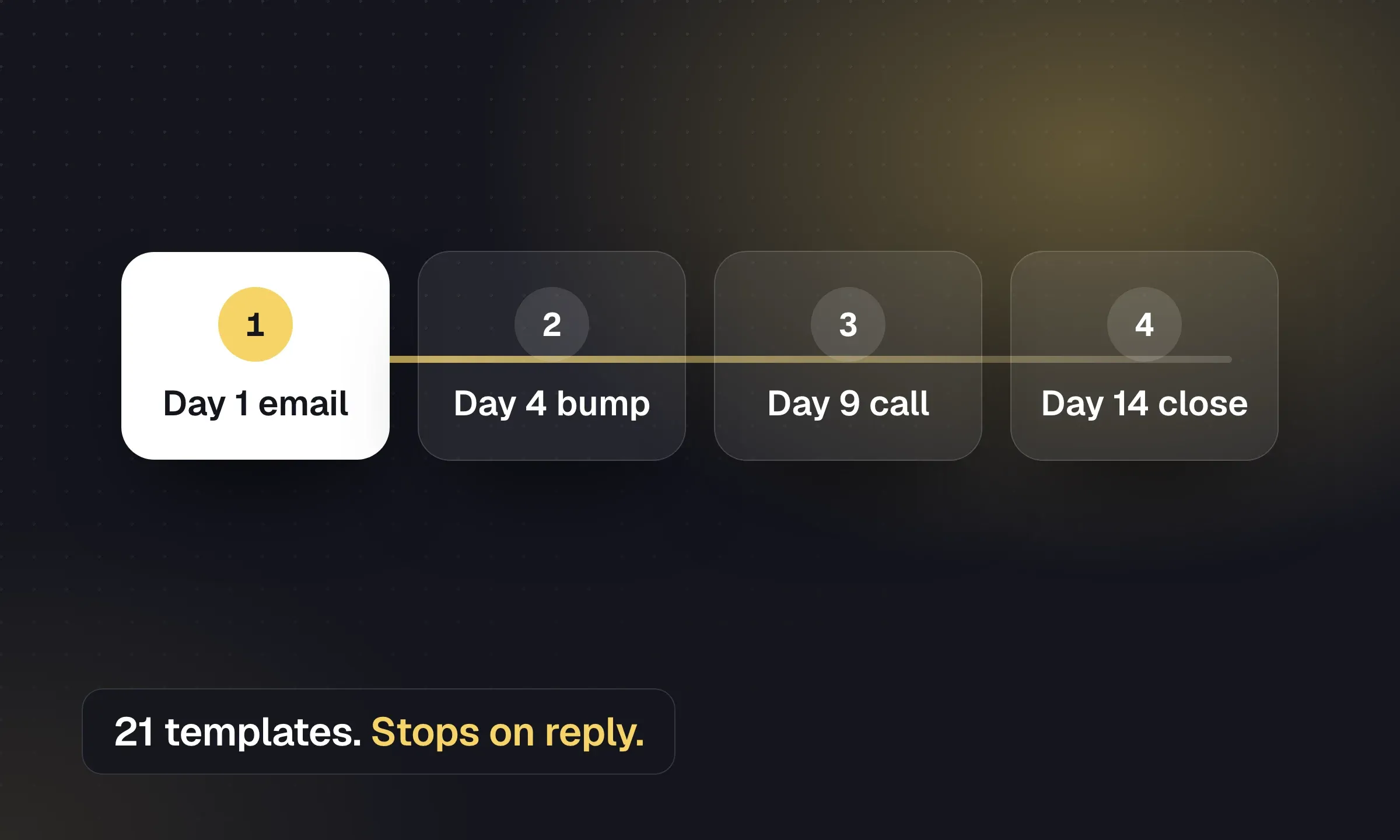
Hiring managers are busy and agency approaches are common. Single emails get missed and single calls go to voicemail. A short, planned sequence across phone, email and LinkedIn gives you several fair chances to be relevant without spamming anyone.
A ten-working-day plan for a Tier A contact:
- Day 1: call, then email. Try the direct line. Whether or not you connect, send a short email that names the signal and asks one question.
- Day 3: LinkedIn connection. No pitch in the note. Engage with something they posted if it’s genuinely relevant.
- Day 5: second call. Different time of day. If you reach voicemail, leave a 20-second message with one specific reason to call back.
- Day 7: value email. A salary data point, a market observation or a candidate profile you can genuinely represent.
- Day 10: final call and a close-the-loop email. Ask whether to check back next quarter or leave it. Then move them to Tier B nurture.
Stop the sequence the moment they reply, ask you to stop, or tell you the role is filled. Automated follow-ups that keep firing after a reply are how agencies get a reputation.
The first email
BD email: signal-led introduction
Subject: Controller search at Northbank
Hi Morgan,
I noticed Northbank has been advertising for a financial controller since early September, and that the Wakefield site opens in the spring.
We place finance managers and controllers with manufacturers across West Yorkshire. Most of the people we speak to are weighing up two or three offers, and site-level manufacturing experience is the hardest part of this brief to find right now.
Is the search still open? If it would help, I can share what similar roles are paying locally and how long they’re taking to fill.
Sam Patel Ridings Finance Recruitment
Everything in that email is checkable: the ad, the site, the agency’s niche. Don’t invent a candidate, a client relationship or urgency you can’t support.
The spec candidate (MPC) approach
Presenting a strong candidate to a company that hasn’t asked for one (often called a spec CV, MPC or “most placeable candidate” approach) is a legitimate way in, with conditions. The candidate must know and agree that you are approaching that company, the profile should be anonymized until there’s interest, and terms must be agreed before you send the full CV.
BD email: anonymized candidate introduction
Subject: Management accountant, manufacturing, available in 4 weeks
Hi Morgan,
I’m representing a management accountant who has spent five years in food manufacturing, most recently leading month-end and standard costing for a two-site business near Bradford. She’s looking for a role with more commercial input and has asked me to approach a short list of local manufacturers, including Northbank.
She’s on four weeks’ notice and looking at around £52k.
Would a short call about whether she’d fit your team be useful? I can send an anonymized profile first.
Sam
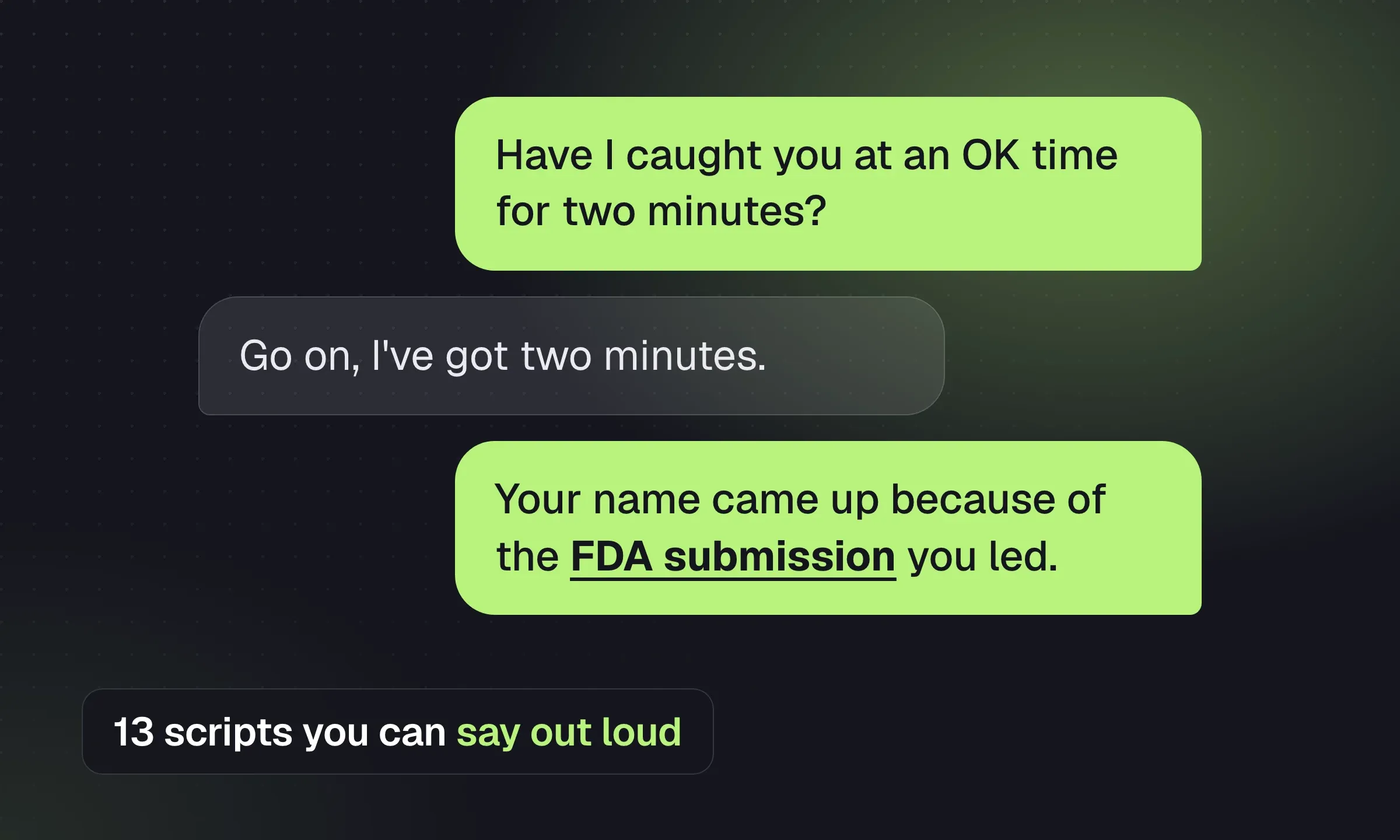
Scripts for the phone versions of both approaches, plus gatekeepers, voicemails and objections, are in recruitment cold call scripts. Full follow-up sequences are in the email sequence templates.
How the numbers can work
Here is an illustrative month for one consultant working a Tier A list. These are invented figures to show the arithmetic, not benchmarks.
- Hiring managers contacted 60
- Conversations 22
- Discovery calls 8
- Terms signed 4
- Briefs worked 3
- Placements 1
At a fictional 20% fee on a £55,000 salary, that one placement is worth £11,000. If the consultant needs two placements a month, the math says either work 120 contacts, or improve the conversion at the stage that leaks most. Check where the drop occurs. Few discovery calls may point to the message or target list; few placements after signed terms call for a review of job qualification and delivery.
5. Run a proper discovery call
A positive reply is not a brief. The discovery call (sometimes called a job take or job qualification call) decides whether this vacancy is worth your desk’s next two weeks. Ask the uncomfortable questions now; they get harder to ask after you’ve sent three CVs.
- Why is the role open: growth, backfill, restructure?
- Is the headcount approved and budgeted, and who signs it off?
- What’s the salary range, and how firm is the top of it?
- What does the interview process look like, and can we hold dates now?
- Who else is working on it: other agencies, internal team, referrals, ads?
- How long has it been open, and what happened to candidates so far?
- What would make you want to meet someone from a CV in ten seconds?
- What would rule someone out immediately?
- What happens to the team if it isn’t filled in the next 60 days?
- Can I speak to you directly for feedback, or does it go through HR?
Write down what you hear, then decide honestly whether to work it.
Green flags
- The hiring manager is on the call and gives you their direct line.
- Approved budget and a named decision maker.
- Interview slots offered before you’ve sent a CV.
- Two or fewer other agencies, or an exclusive window on the table.
- Specific, realistic must-haves.
Red flags
- “Just send over whatever you’ve got.”
- Salary well below what the market is paying, with no flexibility.
- Six agencies already on it, plus job boards.
- No one can say who makes the final decision.
- Requirements change between the call and your follow-up email.
A brief with mostly red flags can still be worth working, but at lower priority, or in exchange for something like exclusivity or a fee on a different basis.
6. Agree fees and terms before any CV moves
Send terms after the discovery call and get them signed before you introduce anyone. Sending a CV before agreeing terms leaves the fee and introduction conditions unsettled, just when you need them to be clear.
Common fee models
Scroll the table to see all columns →
| Model | How it’s paid | Best when |
|---|---|---|
| Contingent perm | Percentage of first-year base salary, on start | Mid-level roles, several agencies likely involved |
| Exclusive contingent | As above, with a fixed exclusive window | You can fill it and want to stop the CV race |
| Retained or engaged | Staged: on engagement, shortlist and placement | Senior or hard roles that need a full search |
| Contract or temp margin | Markup on the hourly or day rate for each hour worked | Contract desks, interim and project work |
| Multi-hire or project | Fixed or reduced fee per hire across an agreed volume | Team build-outs and new sites |
What the terms should cover
- Fee basis. What counts as salary (base only, or bonus and car allowance too), the percentage, and VAT or sales tax treatment.
- Payment terms. When the invoice is raised (offer, start date) and when it’s due.
- Rebate or replacement. What happens if the hire leaves early, over what period, and whether you replace or refund.
- Introduction ownership. How long an introduction stays yours, including if the client hires the candidate for a different role.
- Temp-to-perm transfers for contract desks.
- Data protection, including how the client handles candidate data.
In the UK, the Conduct of Employment Agencies and Employment Businesses Regulations 2003 require agencies to agree terms with a hirer before providing services, which is a good habit everywhere. Have your standard terms reviewed by an employment lawyer once, then use them every time.
Trade, don’t discount
When a client pushes on fee, ask what they’ll give in return. A lower percentage can be fair in exchange for exclusivity for two weeks, interview slots held in advance, two hires on one brief, or faster payment. A straight discount with nothing in return trains the client to ask again next time.
7. Turn the brief into a placement, then the next brief
Most agencies treat BD and delivery as separate jobs. The client doesn’t. The way you run this first search is your best sales pitch for the second one.
Agree the delivery plan on the call. “You’ll have three to five qualified profiles by Thursday the 23rd, and I’ll call you on Friday to go through feedback.” Then do exactly that.
Send fewer, better CVs. Each profile should come with a short written case for why this person fits this brief. The candidate submission template shows the format, and branded CV packs keep it consistent across consultants.
Update the client weekly, even when there’s nothing new. “Spoke to 14 people this week, two in process elsewhere, one strong maybe” is still useful, and it keeps another agency from filling the silence.
After the placement, book the follow-ups before you celebrate:
- Day 1: check the candidate started and the client is happy.
- Week 1: call both sides. Fix small problems while they’re small.
- Month 1: ask the hiring manager how it’s going, and who else in the business is hiring.
- Month 3 (or the end of the rebate period): ask for a short testimonial or a referral to a peer.
- Add every new name you hear to the account and log the next action.
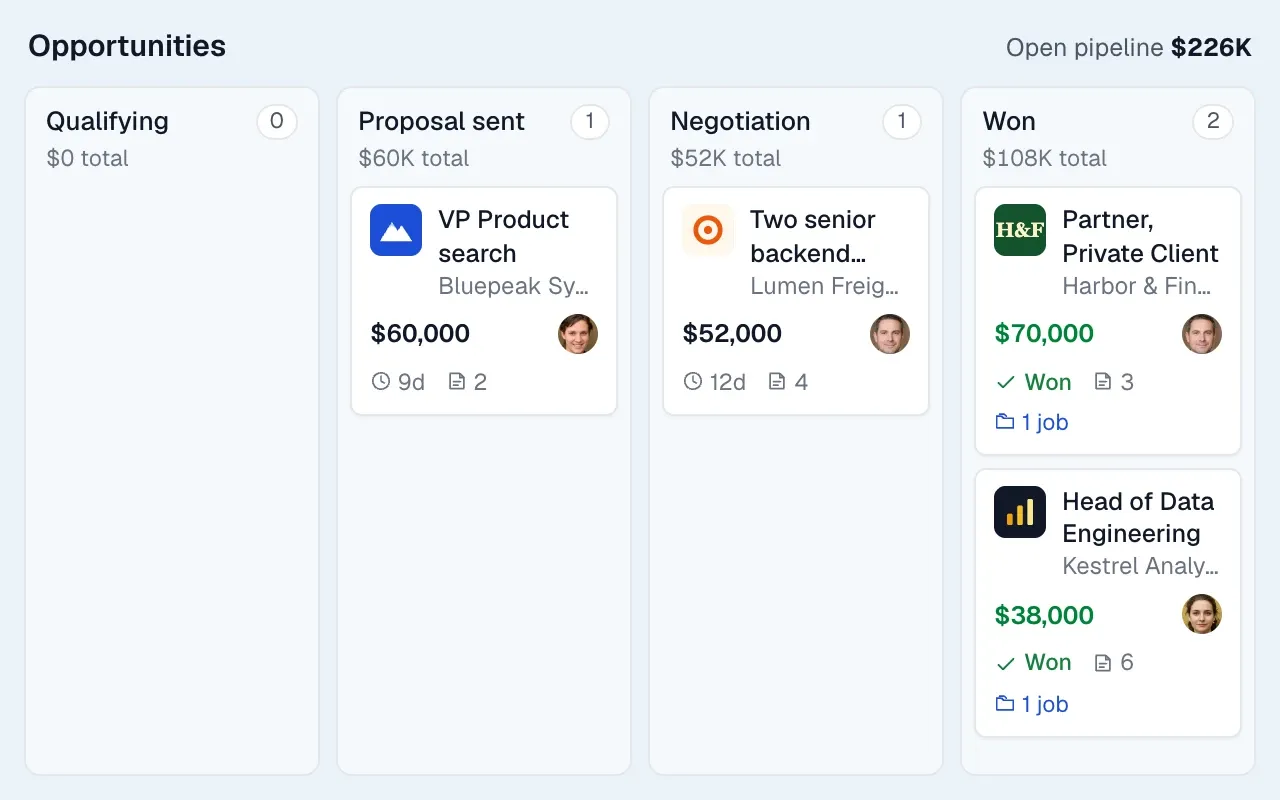
In Longlist, the business development tools put companies, hiring contacts and opportunities next to your candidates, so when a brief is won you create the job under the same company and the conversation history carries over into the applicant tracking system.
Run BD and delivery in one place
Companies, hiring contacts, BD sequences and an opportunities board, in the same CRM your recruiters use to fill the role. Included on every plan.
8. A weekly BD routine that survives a busy desk
The most common BD failure is the feast-and-famine cycle: a consultant stops prospecting when they have five live jobs, and has nothing when those close. Fix it with protected time, not good intentions.
A routine for a billing consultant who also delivers:
Scroll the table to see all columns →
| When | What |
|---|---|
| Monday, 9–10:30 | Call block: Tier A accounts with fresh signals |
| Tuesday, 30 min | Signal review: new job ads, funding news, leadership changes; re-tier |
| Wednesday, 9–10:30 | Call block: follow-ups, voicemail returns, discovery calls |
| Thursday, 45 min | Value touches for Tier B: market note, salary data, candidate profile |
| Friday, 30 min | Update the pipeline, set next actions, review the week’s numbers |
Track a handful of leading indicators: new hiring-manager conversations, discovery calls held, terms signed and qualified briefs. Lagging numbers like placements and fees tell you how last quarter went; the leading ones tell you how next quarter will go. The agency KPI scorecard has definitions and a download, and recruitment reporting in Longlist includes a BD activity view by consultant.