Open with your name and a specific reason for calling this person. Ask a question you want answered, listen, then agree a small next step. The scripts cover candidate and client calls, including the most-placeable-candidate (MPC) approach. Names, companies and numbers are fictional: replace them with details you can support, and respect any request not to be contacted.
Candidate calls
1. The passive candidate approach
The person isn’t looking. Your job is to earn 60 seconds, make the move sound worth a conversation and leave with permission to follow up. Ask permission early; it lowers their guard.
Passive candidate: first call
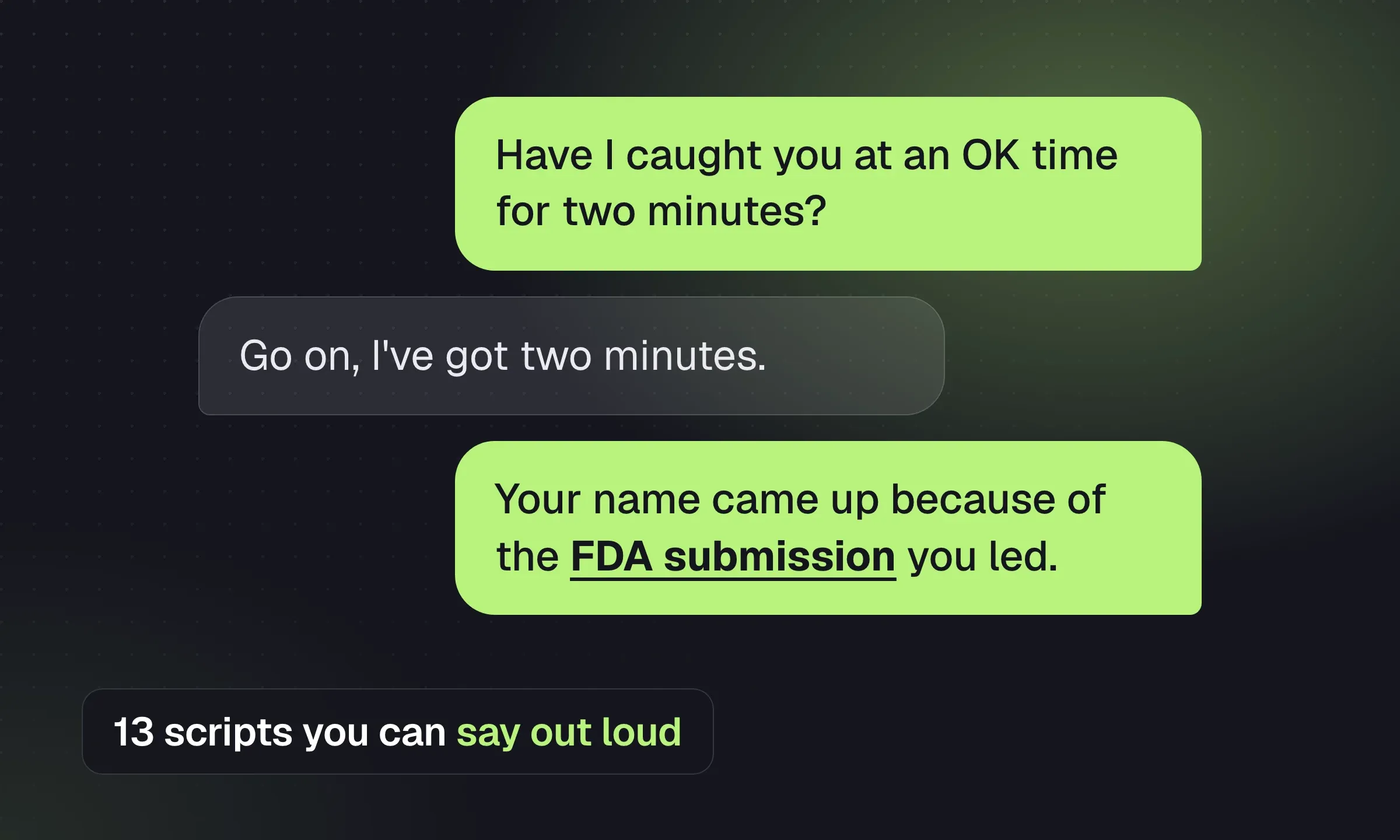
Hi Jordan, it’s Alex from Ridings Recruitment. Have I caught you at an OK time for two minutes, or is there a better time to call back?
[If yes]
Thanks. I’ll be quick. I specialize in quality and regulatory roles in medical devices, and your name came up because of your work on the [specific product line / audit / certification] at [current company].
I’m working with a [type of company, e.g. 200-person device manufacturer in Austin] that’s building out its quality team. The role is a [title], reporting to the VP of Operations, and the reason I thought of you is [specific: they’re preparing for an FDA submission / they need someone who’s led a CAPA program].
I’m not assuming you’re looking. Can I ask what would have to be true for a move to be worth considering in the next six months?
[Listen. Take notes. Ask follow-up questions about money, commute, team, growth.]
That’s really useful. Based on that, this one may or may not fit. Would it help if I sent you a short summary of the role to read in your own time, and we pick up again on Thursday?
[If not interested]
Completely fair. Who’s the best quality engineer you’ve worked with who might be open to a conversation? And would you mind if I kept in touch about roles that match what you’ve just told me?
If they offer a referral, log the name and who suggested it before the next call.
2. The applicant callback
They applied, so the call is warm. The aim is to qualify quickly and sell the next step, not repeat the job ad back to them.
Applicant callback
Hi Priya, it’s Alex from Ridings Recruitment. You applied for the quality engineer role we advertised on Tuesday. Is now still a good time for ten minutes?
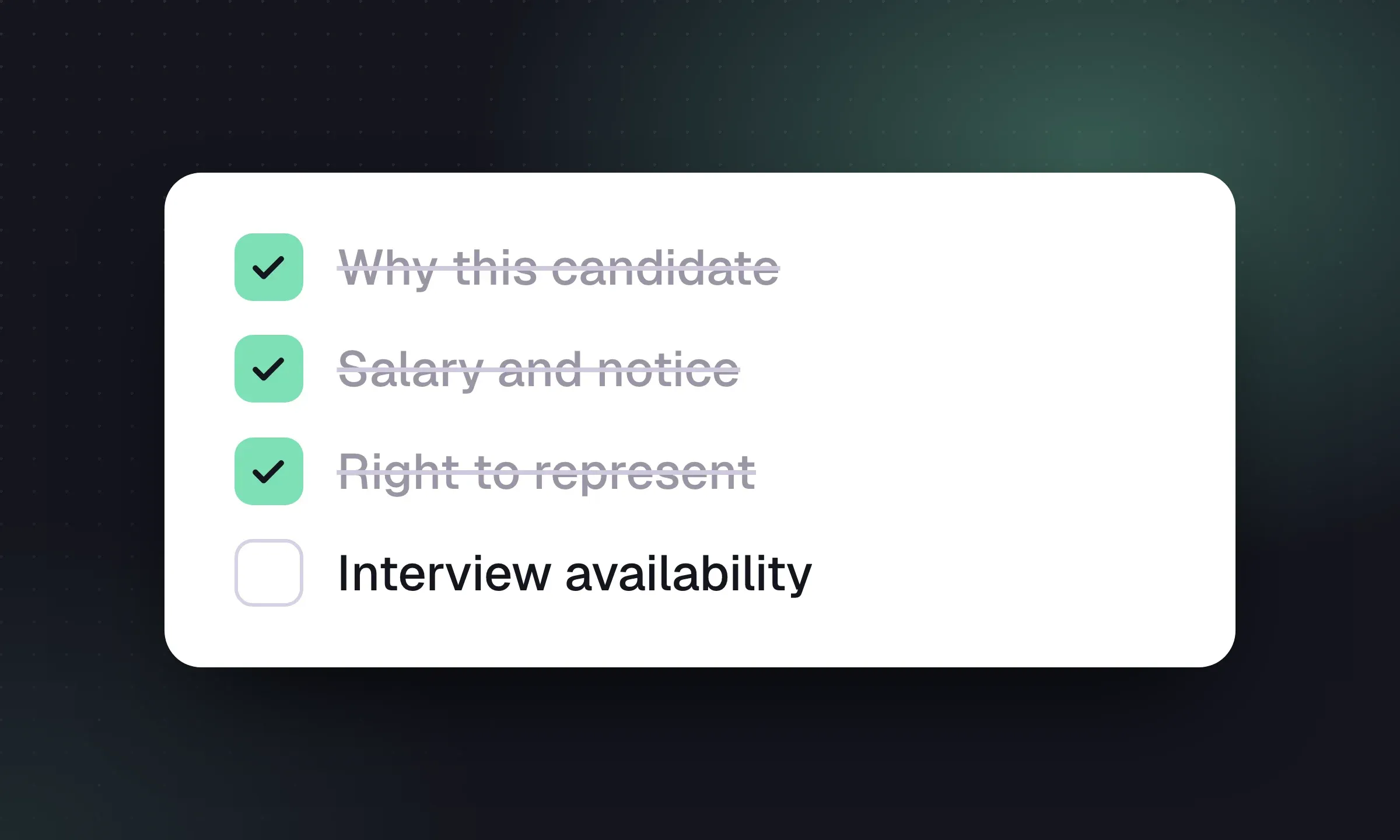
Great. I’ve read your CV, so I’ll skip the basics. Three quick things so I can tell you honestly whether it’s a fit:
- What’s prompting the move?
- The salary for this one is [range]. Does that work for you?
- Your notice period, and any interviews already in progress?
[Listen. If there’s a fit:]
Based on that, I’d like to put you forward. Before I do, I’ll send you a short summary of the role and the client, and I won’t share your CV with anyone without checking with you first. Can we speak again tomorrow at 12 to go through it?
[If no fit:]
I’ll be straight with you: this one isn’t right, because [reason]. But [what you heard] is useful, and I’d like to keep you in mind for roles like [type]. Is that OK?
3. Re-engaging a candidate in your database
Your CRM is full of people you spoke to months ago. Calling them with context beats starting cold every time. Read the record first.
Database re-engagement call
Hi Sam, it’s Alex from Ridings Recruitment. We spoke back in March when you were weighing up the move to [company]. Did that happen in the end?
[Listen and update the record.]
The reason I’m calling: I’m working on a [role] that looks a lot like what you described then, [specific overlap]. Has anything changed since March, or would it be better if I left this one and kept you in mind for later in the year?
For finding these people quickly, database rediscovery and sourcing covers searches that resurface past candidates, and the Boolean search guide helps when the search is wider.
Client calls
4. The signal-led BD call
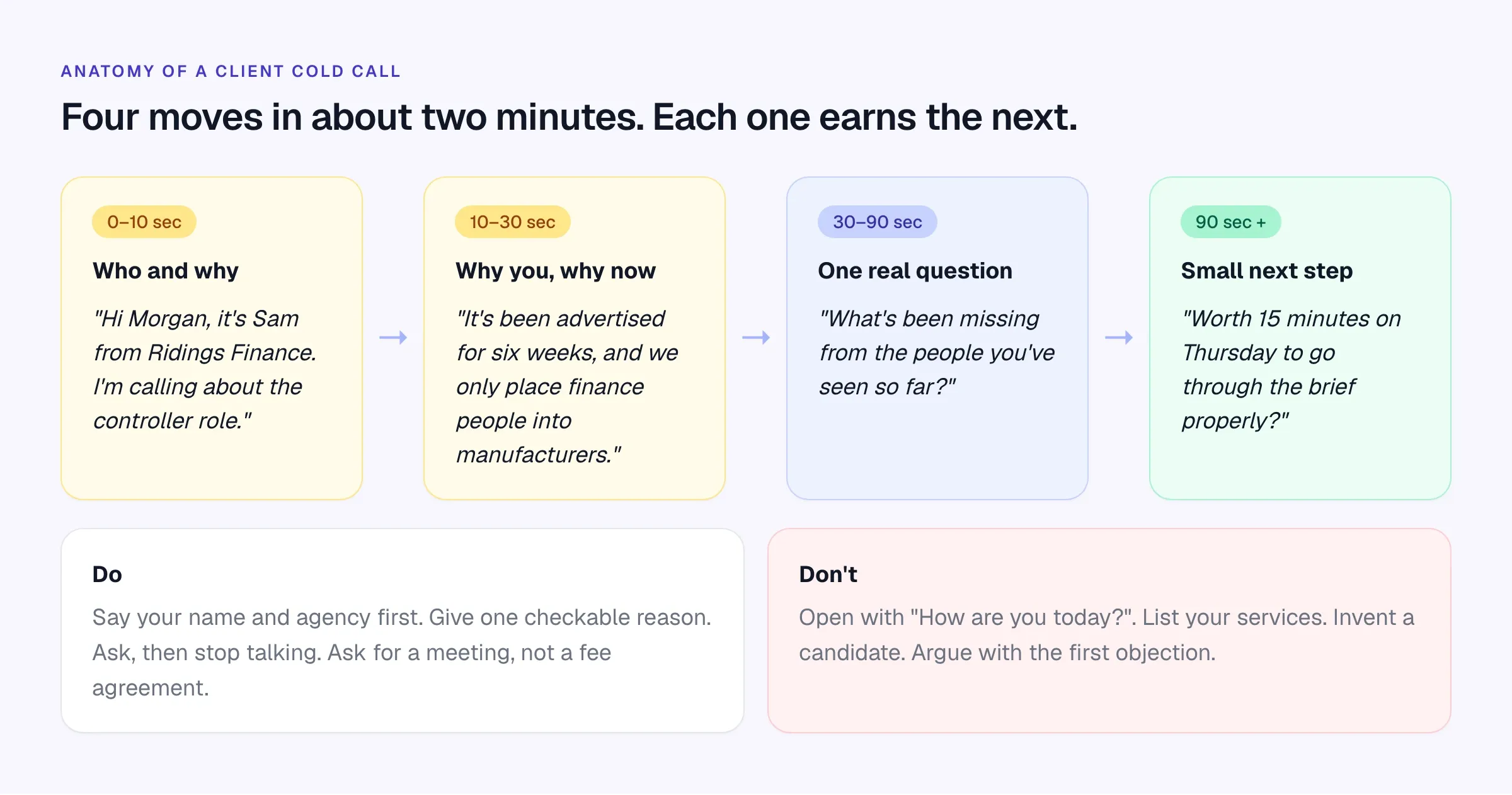
This is the core business development call: a hiring manager at a target account, a public signal, a request for a short meeting. Where the signals come from is covered in recruitment lead generation.
Client BD call: stale job ad
Hi Morgan, it’s Sam Patel from Ridings Finance Recruitment. I’m calling about the financial controller role. Have you got a minute?
[If yes]
Thanks. I noticed it’s been advertised since early September. We only place finance people into manufacturers around Leeds and Bradford, so I see a lot of controllers with site-level experience.
Can I ask how the search is going? What’s been missing from the people you’ve seen so far?
[Listen. Ask one or two follow-ups: timeline, salary, what happens if it isn’t filled.]
That’s helpful. From what you’ve said, the hard part is [their problem]. I’d suggest 15 minutes on Thursday to go through the brief properly, and I can bring a view on what that profile is paying locally right now. Does 10am or 2pm work better?
Ask for a meeting, not a fee agreement. Terms come after the brief is qualified; the client-finding guide covers discovery questions and fees.
5. The new leader or the old client who moved
A new head of a function often reshapes the team, and a past client who’s changed companies already knows your work. Both calls are about them, not about a vacancy.
Client call: past client contact in a new role
Hi Chris, it’s Sam from Ridings. I saw you’ve moved to Fernhill Labs. Congratulations.
I won’t keep you. I wanted to say well done, and ask what you’ve walked into. Is the team in the shape you want it, or are there changes coming?
[Listen.]
If it helps, I’m happy to send you a quick picture of what the finance market looks like in Austin right now, since it’s a different patch from your last role. And when you’re ready to hire, you know how we work.
6. The MPC (spec CV) call
MPC stands for most placeable candidate: you call a target client about a strong candidate you represent, even though they haven’t advertised. Done right, you’re starting a relationship with something valuable. Done wrong, you’re spraying someone’s details around the market.
Rules before you dial:
- The candidate has agreed to the approach, to this company specifically.
- You describe the candidate without identifying them (no name, no current employer by name, nothing that makes them obvious).
- Terms are agreed before you send the full CV.
MPC call to a hiring manager
Hi Morgan, it’s Sam from Ridings Finance Recruitment. I’ll be brief: I’m representing a management accountant I think you’d want to know about, and I wanted to check before sending anything.
She’s spent five years in food manufacturing, most recently running month-end and standard costing across two sites. She’s looking for a role with more commercial input, is on four weeks’ notice, and is looking at around £52k. She asked me to approach a short list of manufacturers in West Yorkshire, and Northbank is on it.
I know you may not have a role open. Would it be worth a short conversation about whether she’d add something to your team? I can send an anonymized profile first.
[If interested]
Great. I’ll send the anonymized profile today, with our terms, and if you’d like to meet her, I’ll set it up once those are signed.
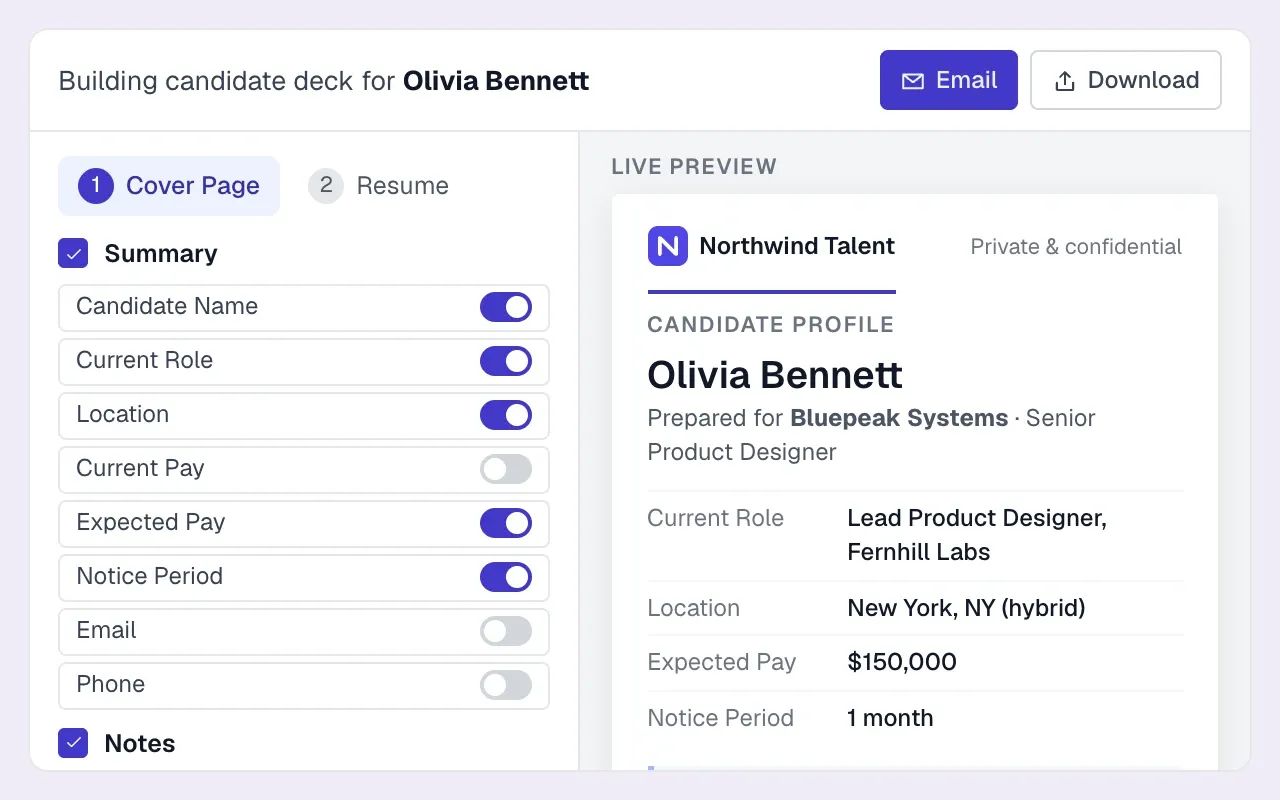
Longlist’s CV formatting can produce a branded pack with a cover page, and the BD tools let you link a candidate to a client opportunity so the introduction stays on the record. The candidate submission template covers what to write alongside the profile.
Gatekeepers and voicemail
7. The gatekeeper
Receptionists and executive assistants are doing their job, which includes screening calls like yours. Be clear, brief and honest. Don’t pretend to be a client or claim a relationship you don’t have.
Gatekeeper
Hi, it’s Sam Patel from Ridings Finance Recruitment. Could you put me through to Morgan Hale, please?
[If asked what it’s regarding]
It’s about the financial controller role you’re advertising. I specialize in finance hires for manufacturers, and I’d like two minutes with Morgan to ask how the search is going.
[If they won’t put you through]
That’s fine. What’s the best way to reach Morgan: is email better, or is there a good time to call back? And may I ask your name, so I can mention we spoke?
Write the gatekeeper’s name and suggested contact route in the CRM, so your next call picks up from this one.
8. Voicemails
Keep voicemails to about 20 seconds: name, agency, one specific reason, and your number said slowly twice. A voicemail works best as part of a sequence with an email that lands the same day.
Voicemail: client
Hi Morgan, it’s Sam Patel from Ridings Finance Recruitment. I’m calling about the financial controller role. We place finance people into manufacturers around Leeds, and I’ve got a view on what that profile is paying locally that might be useful. I’ll send you a short email now. My number is 0113 496 0000, that’s 0113 496 0000. Thanks.
Voicemail: candidate
Hi Jordan, it’s Alex from Ridings Recruitment. I’m calling about a quality role at a device manufacturer in Austin that lines up with your CAPA work. No pressure at all; I’ll drop you a note on LinkedIn and email with the details. If it’s of interest, I’m on 512 555 0142, that’s 512 555 0142.
9. The follow-up call after an email
Refer to the email and ask whether the role is still open.
Follow-up after an email
Hi Morgan, it’s Sam from Ridings. I emailed on Tuesday about the controller role and the local salary picture. Is the role still open, or did you manage to fill it?
If they say it’s filled, congratulate them, ask how they found the person, and ask whether anything else is coming up. That’s a useful conversation, not a lost one.
Before you dial: a five-minute prep
Cold calls fail most often before they start, because the recruiter has no reason to call this person today. Spend five minutes per call block on prep.
- I know why I’m calling this person today (a role, a signal, a referral).
- I’ve read the CRM record: past calls, emails, notes and any opt-outs.
- I have one question I genuinely want answered.
- I know the small next step I’ll ask for.
- I’ve decided what I’ll say if I get voicemail.
- The number is screened where required (TPS/CTPS in the UK).
Then block the time. One focused hour of calls, with records queued and no email open, usually beats a day of calls scattered between other work.
Objection handling
The objections are predictable, so prepare for them. The pattern that works is: acknowledge, ask a question, offer something small. Never argue with the first “no”.
Scroll the table to see all columns →
| Objection | What it often means | Try |
|---|---|---|
| “We don’t use agencies.” | “We’ve had bad experiences” or “budget’s tight” | “Understood. Is that a policy, or has it just not been needed? If a role ever stalls, would it help to know who to call?” |
| “We have a PSL.” | You’re not on it | “Makes sense. When’s it next reviewed, and who manages it? I’d like to earn a place on it properly.” |
| “Just send me some CVs.” | Brush-off, or they want free introductions | “Happy to, once I know what good looks like. Can I ask three quick questions about the role first?” |
| “Your fees are too high.” | Haven’t heard what they’re getting | “What would you need to see to make the fee worth it? Speed, exclusivity, a replacement guarantee?” |
| “We’re not hiring.” | Not right now | “Fair enough. When do you usually plan headcount? Would a quarterly market update be useful meanwhile?” |
| “Email me.” | Polite exit, sometimes genuine | “Will do. So it’s useful and not just another email, what’s the one thing you’d want to know?” |
Candidate objection: “I’m happy where I am”
That’s good to hear, and I’m not trying to change that. Can I ask what makes it a good place to be? [Listen.] If those things ever changed, what would you look for next? I’ll only get in touch if something genuinely matches that.
Anyone: “How did you get my number?”
Fair question. [Give the honest source: your LinkedIn profile, a referral from X, your company website, or a contact data provider.] If you’d rather I didn’t call this number, I’ll note that now and won’t use it again.
If someone asks you not to call again, record it in the CRM straight away and make sure the whole team can see it.
Run calls as part of a sequence
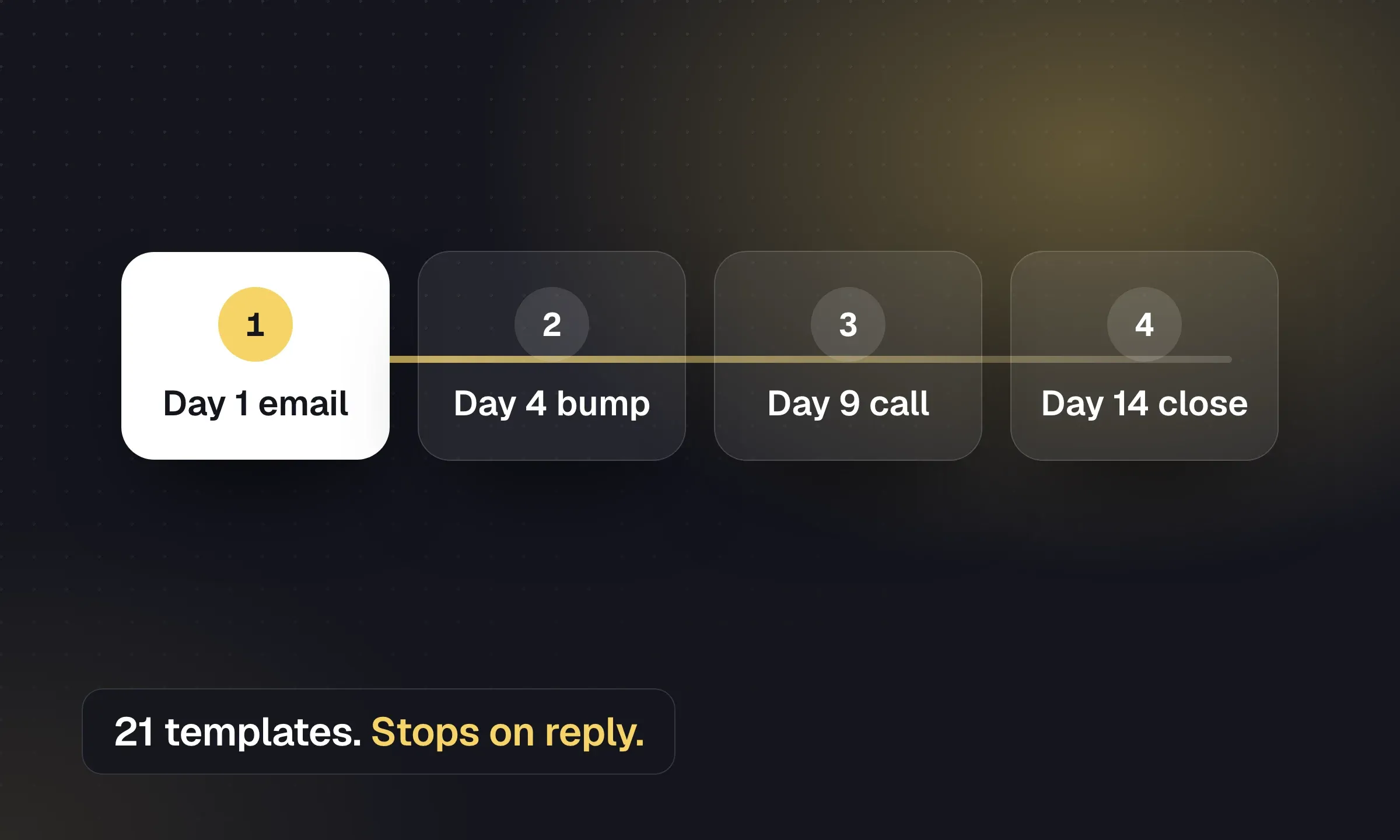
Cold calls work best alongside email and LinkedIn, not instead of them. A typical client sequence alternates them: email and call on day one, LinkedIn on day three, a second call on day five, a value email on day seven. The email sequence templates include the emails that sit between these calls.
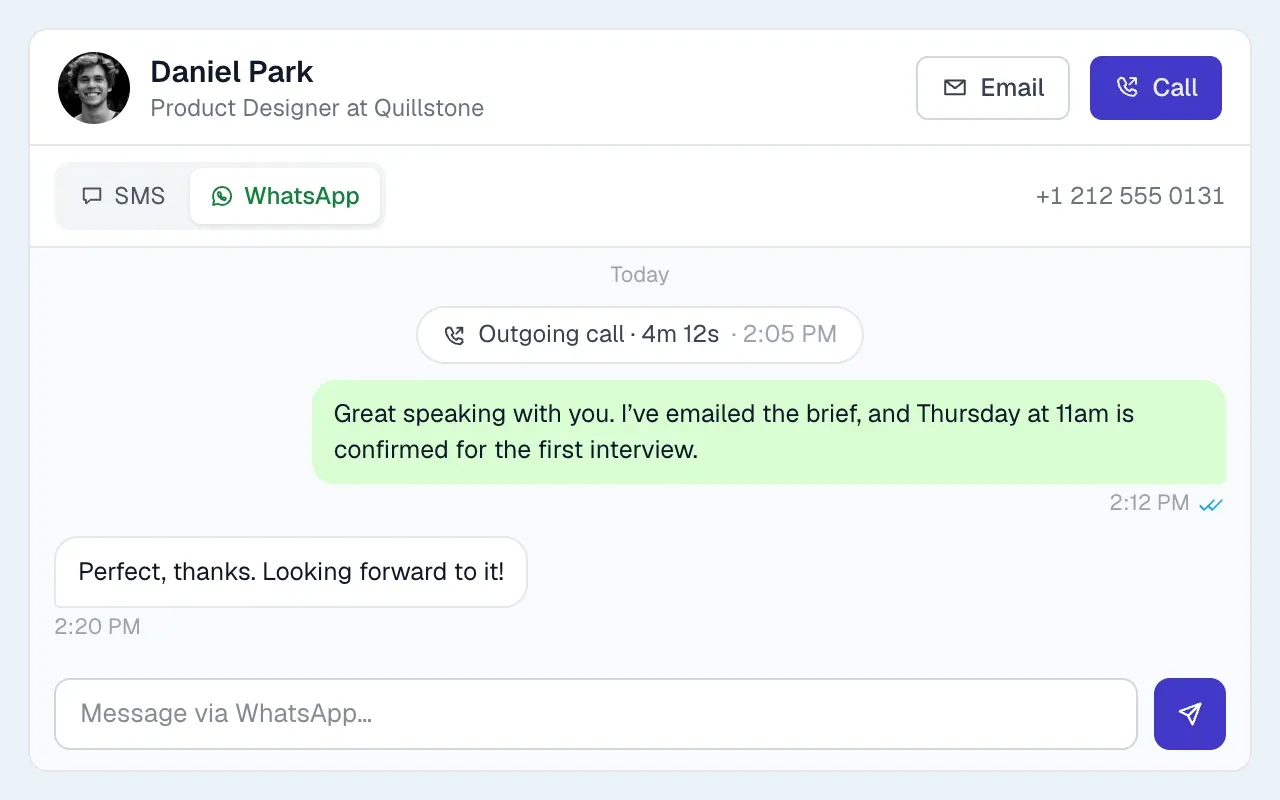
In Longlist, call steps in a sequence become tasks with a due date, so the calls happen on schedule instead of when you remember. On the Plus plan, calling, SMS and WhatsApp are built in: click to call from the record in your browser, and each call’s direction, status and duration is logged automatically. Calls are logged, not recorded, so add your own notes.
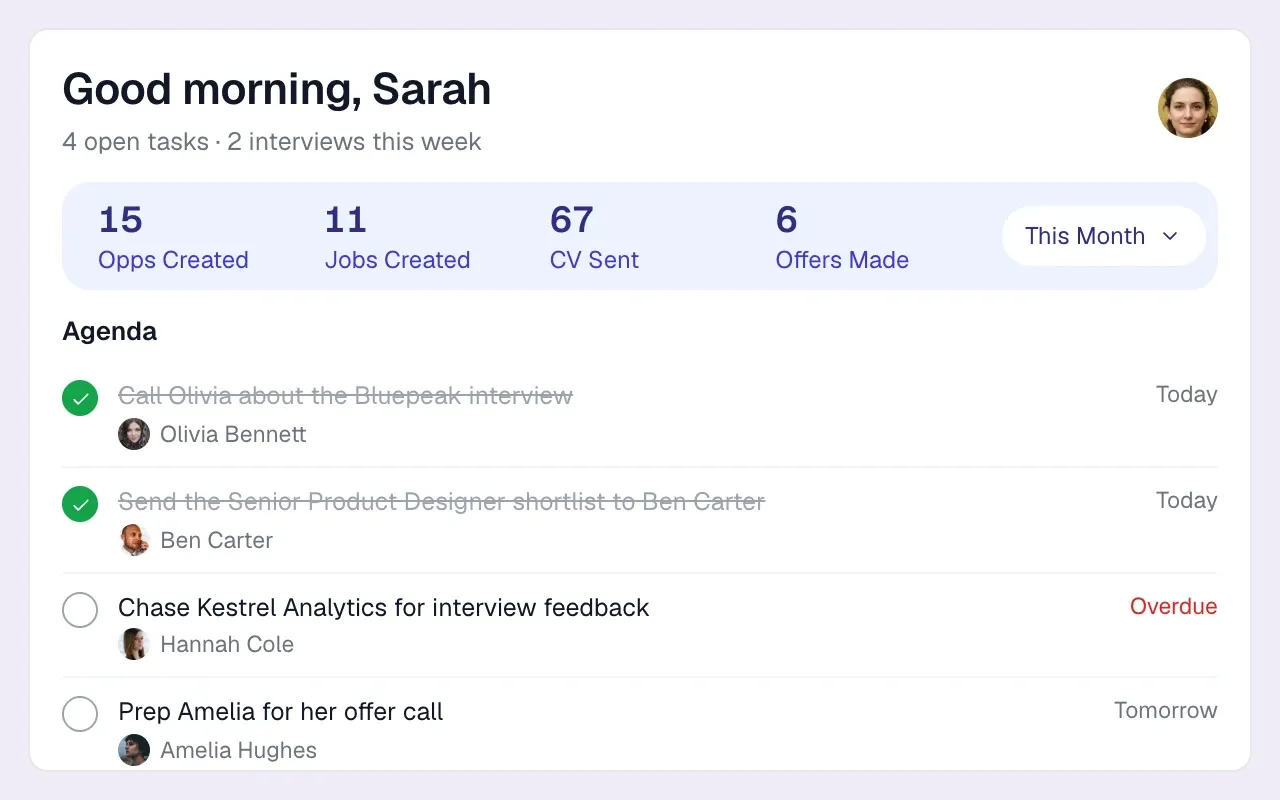
Make the calls from the record
Click-to-call, two-way SMS and WhatsApp from every candidate and client record, with calls logged automatically. Available on Plus.
Measure your calls
Track four numbers per call block for a month: dials, connects, conversations (more than a minute of real dialogue) and next steps agreed. An illustrative two-hour client call block might look like this:
- Dials 40
- Connects 9
- Conversations 5
- Meetings booked 2
These figures are invented to show the arithmetic. Here, 9 ÷ 40 is a 22.5% connect rate and 2 ÷ 5 is a 40% conversation-to-meeting rate. If your connect rate is low, change the time of day or the data. If conversations don’t turn into meetings, the opener or the question needs work. The agency KPI scorecard shows how to put call numbers next to CVs sent and interviews, and recruitment reporting in Longlist shows calls alongside the rest of the activity.