If your agency places contractors with clients abroad, decide who will contract with each worker before comparing software. A payments platform handles administration; a contractor of record (COR) takes on specified classification responsibilities; an employer of record (EOR) employs the worker. Those differences affect your liability, your placement margin and whether the provider permits you to supply the worker to a client.
Four ways to place a contractor abroad
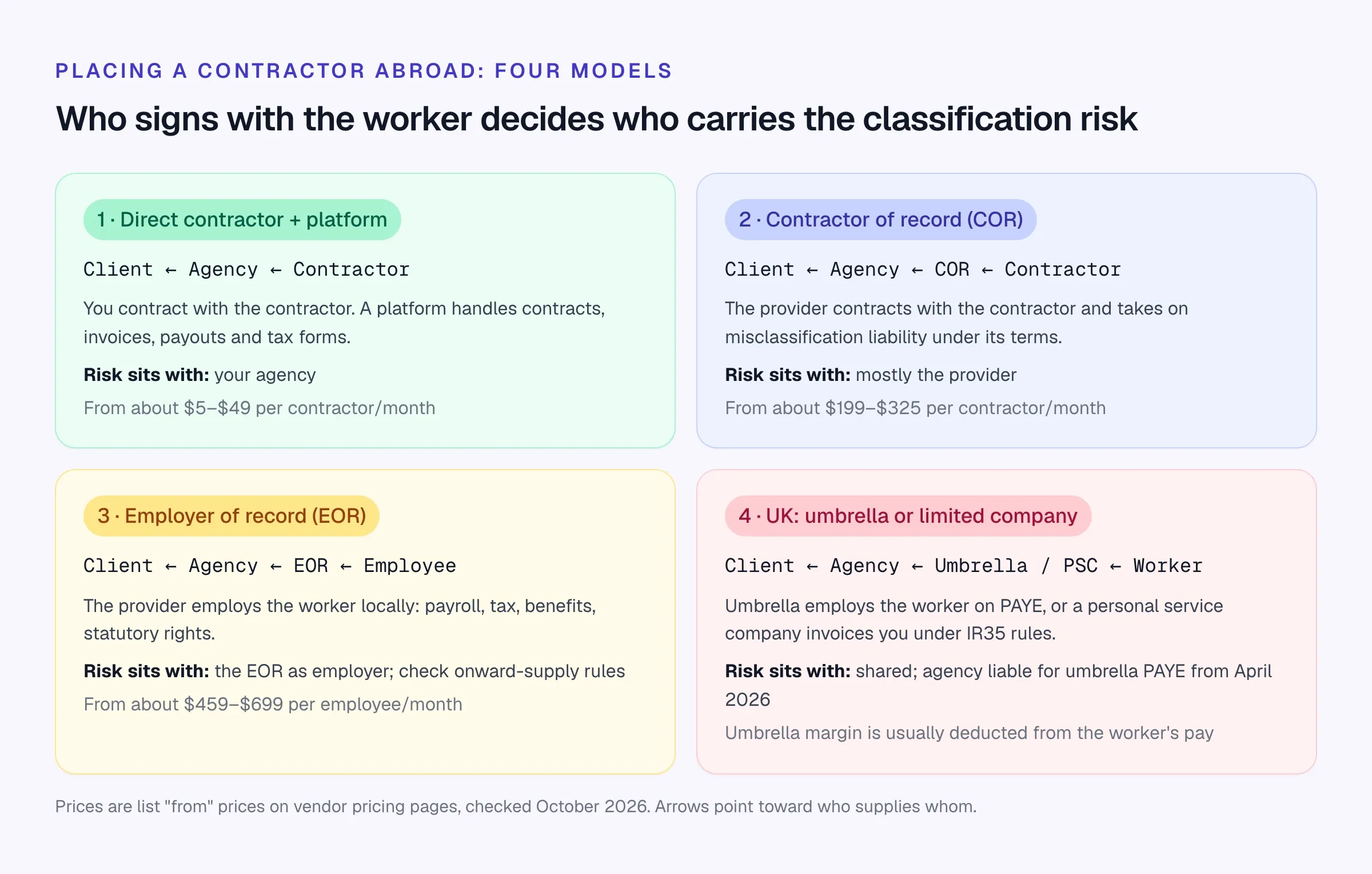
- Direct contract plus a contractor management platform. Your agency contracts with the contractor (or their company). The platform generates the contract, collects invoices, pays out and stores tax forms. Classification risk stays with you.
- Contractor of record (COR). The provider contracts with and pays the contractor, then invoices you. Under its terms it takes on misclassification liability. Deel’s COR page says it signs a Deel standard agreement with the contractor and takes on liability and indemnification for each one.
- Employer of record (EOR). The provider employs the person in their country, runs local payroll, tax and benefits, and invoices you the cost plus a fee. Use it when the role looks like employment.
- UK only: umbrella company or limited company. An umbrella employs the contractor on PAYE and invoices you, or the contractor’s own personal service company invoices you and IR35 rules decide how tax works.
Contractor of record
- Person stays an independent contractor
- Provider contracts with and pays them
- Provider takes on misclassification liability under its terms
- Cheaper than EOR: list prices from $199 to $325 a month
- Only works where the role qualifies as independent contracting
Employer of record
- Person becomes a local employee of the provider
- Payroll, tax, benefits and statutory rights handled locally
- Employer costs passed through on top of the fee
- List prices from $459 to $699 a month
- Check the provider allows onward supply to your client
Choosing the model for a placement
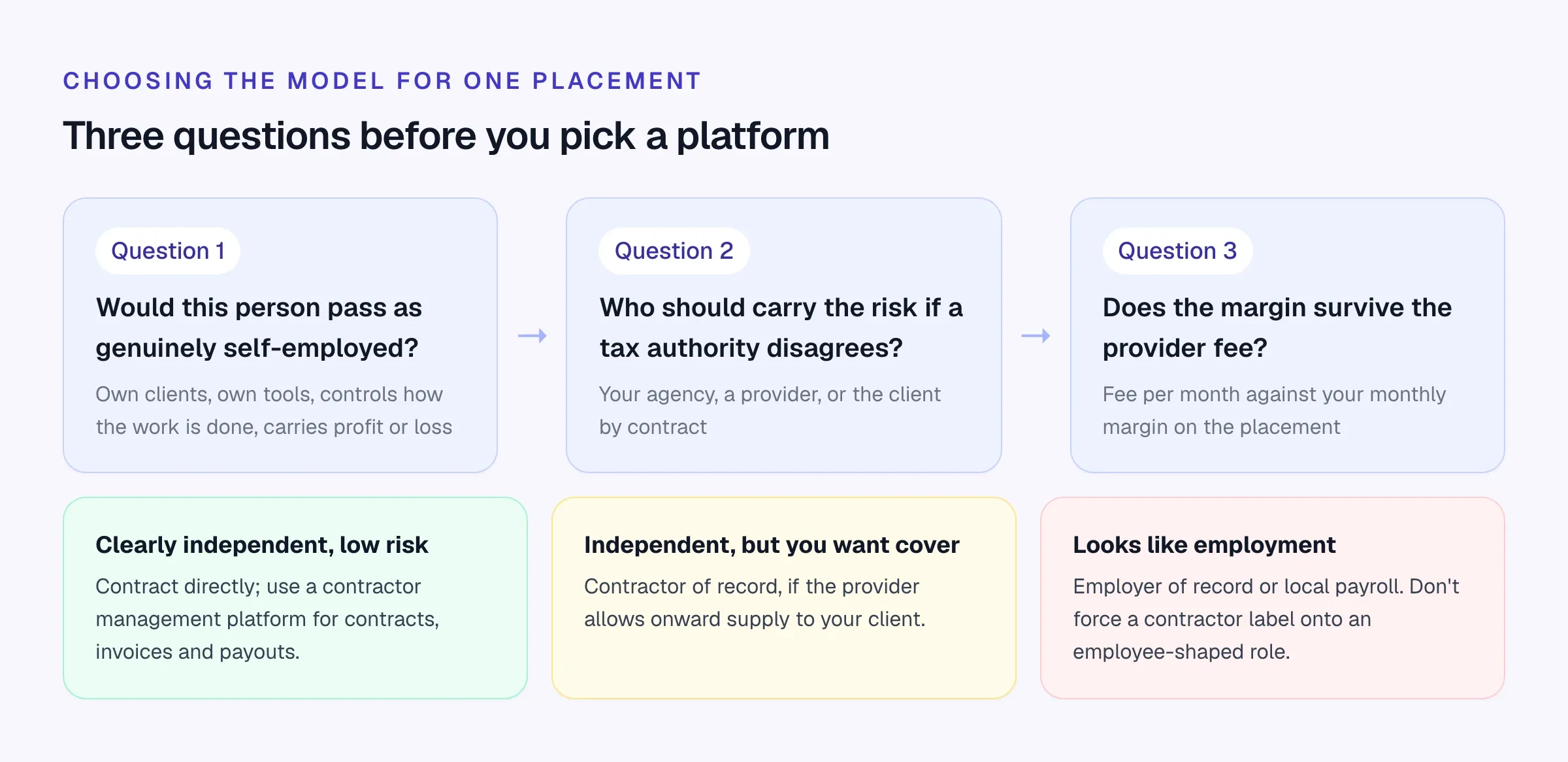
The first question is the one agencies are most tempted to skip. A developer working full time, on the client’s laptop, in the client’s sprint team, managed by the client’s engineering lead, for eighteen months, looks a lot like an employee whatever the contract says. A COR provider may decline that person, and a tax authority may disagree with your label.
Will the margin survive the fee?
Take a fictional US agency placing a Brazil-based software developer with a US client.
- Bill rate $85 an hour, contractor rate $65 an hour: margin $20 an hour
- At 160 hours a month: 160 × $20 = $3,200 monthly margin
Scroll the table to see all columns →
| Model | Example monthly fee | Share of the $3,200 margin |
|---|---|---|
| Contractor management platform | $49 (Deel) | 49 ÷ 3,200 = 1.5% |
| Contractor of record | $325 (Deel or Remote) | 325 ÷ 3,200 = 10.2% |
| Employer of record | $599 (Deel, Remote or G-P) | 599 ÷ 3,200 = 18.7%, before employer costs |
The EOR line understates the real cost: as an employee, the developer comes with employer social security contributions and any mandatory benefits, which the EOR passes through. In practice that means repricing the placement, not just absorbing a fee, and it’s worth tracking margin per placement in your weekly KPI review. Our breakdown of what recruitment software costs has a worksheet you can adapt for per-placement costs like these.
The rules to check first
UK: IR35, umbrellas and the 2026 changes
- Off-payroll working (IR35). Since 6 April 2021, the client usually decides the contractor’s employment status and gives reasons in a status determination statement. Where the rules apply, the deemed employer deducts income tax and employee National Insurance and pays employer National Insurance (HMRC). In an agency chain, that’s usually the agency paying the contractor’s company. HMRC’s CEST tool is the starting point for status checks.
- Small clients. Small clients are outside the off-payroll rules, and the contractor’s company decides status. For financial years beginning on or after 6 April 2025, the Companies Act thresholds increased to turnover up to £15 million and a balance sheet up to £7.5 million; the 50-employee threshold stayed unchanged. Meeting two of three determines size, subject to the relevant-year and two-year rules. These changes do not remove off-payroll responsibilities in April 2026: HMRC says the earliest practical effect is the 2027/28 tax year.
- Umbrella company PAYE. For payments from 6 April 2026, the agency with the contract to supply the end client (or the end client, if there’s no agency) is jointly and severally liable for PAYE that a non-compliant umbrella fails to pay (HMRC policy paper). Your umbrella due diligence is now your own tax risk.
- Umbrella regulation. The government is also bringing umbrella companies within the legal definition of an employment business, so they’ll be regulated alongside agencies (GOV.UK). Watch for commencement dates.
US: classification is mid-change
- Federal (FLSA). The Department of Labor’s 2024 independent contractor rule took effect on 11 March 2024. On 26 February 2026 the DOL proposed rescinding it and returning to a framework that weights control and opportunity for profit or loss most heavily; comments closed on 28 April 2026. Check the DOL rulemaking page for whether a final rule has been published.
- Tax. The IRS applies its own common-law control tests for employment taxes.
- States. Some states are stricter. California applies the ABC test for many purposes.
Everywhere else: onward supply
An EOR employs the worker; your agency then supplies that worker to a client. In some countries, that onward supply is regulated labor leasing. In Germany, for example, an EOR arrangement generally needs an employee-leasing licence (Orrick). EOR contracts can also restrict onward supply. Ask before you quote a client.
The platforms, compared
Prices below come from each vendor’s own pricing page, checked in October 2026. Most are “starting at” prices; country, volume and add-ons change the quote.
Scroll the table to see all columns →
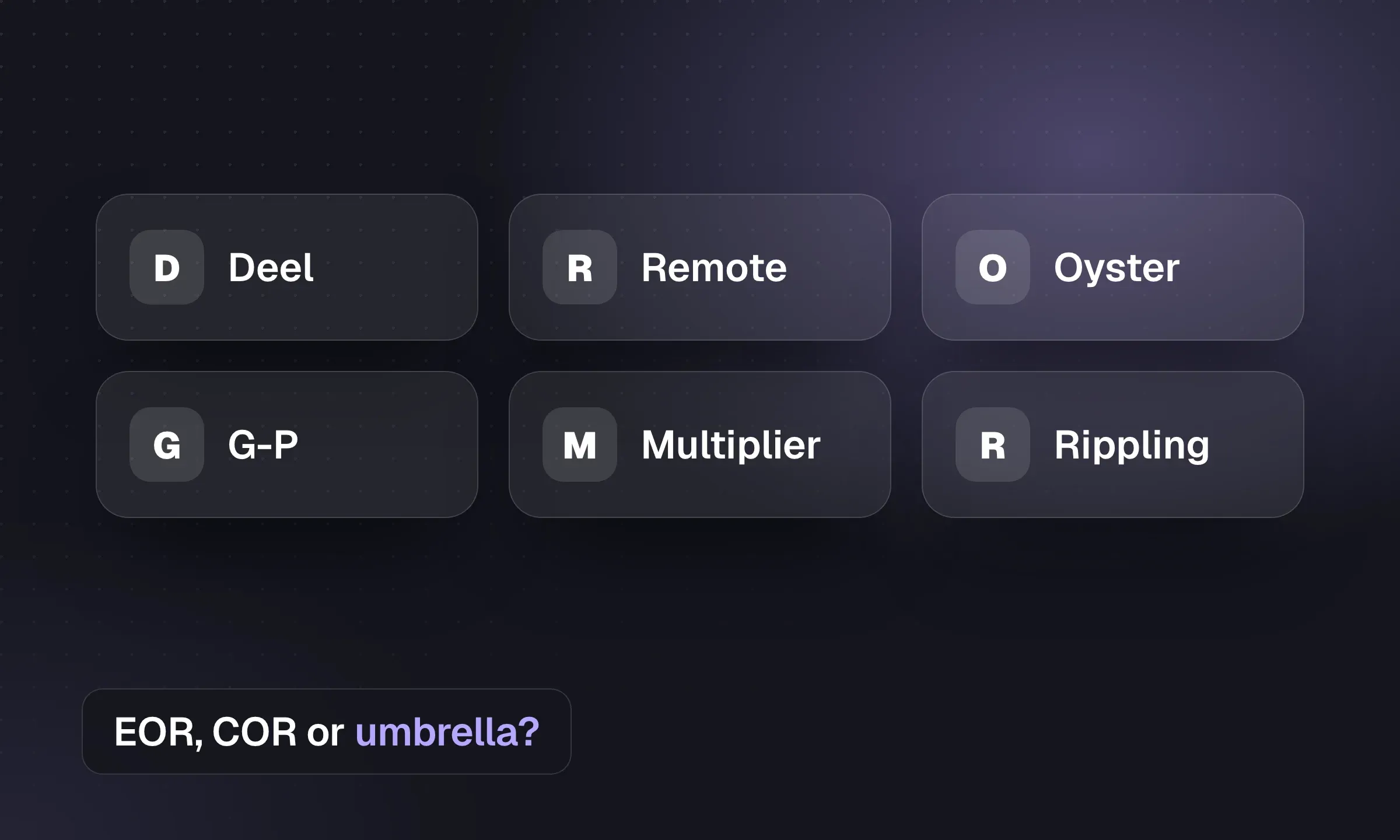
| Provider | Contractor management | Contractor of record | Employer of record | Notes |
|---|---|---|---|---|
| Deel | $49 / contractor / month | $325 / month | $599 / month | Month-to-month, no long-term commitment per its FAQ |
| Remote | From $29 (Plus from $99) | From $325 / month | From $599 / month | Starting prices; startup discounts on some plans |
| Oyster | $29 / contractor / month | Not listed | $699 / month | First 30 days free for contractors; refundable EOR deposit |
| G-P | From $39 / contractor / month | Not listed | From $599 / month | Volume discounts on request |
| Multiplier | Ask | Ask | From $459 / month, billed annually | Growth plan from $519 |
| Papaya Global | From $5 / contractor / month | From $199 / month | From $499 / month | Quotes for mass contractor onboarding (1,000+) |
| Rippling | By quote | Not listed | By quote | Plans start at $8 per employee per month plus a base fee |
Deel
Website ↗- Best for
- Agencies that want contractor, COR and EOR from one provider, month to month
- Pricing
- $49 per contractor/month; COR $325; EOR $599
The most complete menu for agencies mixing models: contractor management, contractor of record and EOR on published prices, plus a US PEO. Its COR terms say Deel contracts with the contractor and takes on liability and indemnification. Check onward-supply terms before using EOR for client placements.
Remote
Website ↗- Best for
- Cost-conscious agencies with a mix of contractors and EOR hires
- Pricing
- Contractor Management from $29; Plus from $99; COR from $325; EOR from $599
A published $29 contractor-management option, with a Contractor Management Plus tier and a separate contractor of record product. Also offers global payroll from $29 per employee where you already have an entity.
Oyster
Website ↗- Best for
- Agencies paying a modest number of contractors in many countries
- Pricing
- Global Contractors $29 per contractor/month; EOR $699
Contractors are free for the first 30 days, then billed per active contractor with no minimums. EOR employees need a refundable deposit. No contractor of record product is listed on the pricing page.
G-P
Website ↗- Best for
- Larger agencies that want an established EOR network
- Pricing
- Contractor from $39 per contractor/month; EOR from $599
Globalization Partners, trading as G-P. Published starting prices with negotiated rates for larger contractor pools and quote-based bundles.
Multiplier
Website ↗- Best for
- Agencies that mainly need EOR on an annual commitment
- Pricing
- EOR Core $459, Growth $519 per person/month billed annually
EOR pricing is published by tier, with compliance add-ons and implementation fees where they apply. Contractor of record and global payroll are listed as separate products; ask for current contractor pricing.
Papaya Global
Website ↗- Best for
- High-volume contractor payouts
- Pricing
- Contractor from $5 per contractor/month; COR from $199; EOR from $499
The lowest published contractor and COR starting prices in this list, plus a mass onboarding option for 1,000+ contractors. Most plans route to a quote, so confirm what the starting price includes.
Rippling
Website ↗- Best for
- Agencies already running their own HR and payroll on Rippling
- Pricing
- From $8 per employee/month plus base fee; global products by quote
A broad HR, IT and finance platform rather than a contractor specialist. Contractor payments, EOR and global payroll are available but priced by quote. Makes most sense if your internal team is already on it.
Questions to send any provider
Get these answered in writing before you put a provider in front of a client:
Due diligence email to a contractor or EOR provider
Subject: Supplying contractors to our clients – [Agency name]
Hi [Name],
We’re a recruitment agency planning to place [number] people in [countries] with our clients, starting [month]. Before we choose a provider, could you confirm in writing:
- Does your contract allow us to supply your contractors or employees onward to our end clients in [countries]? Any countries where you don’t allow it?
- For contractor of record: what misclassification liability and indemnity do you take on, up to what limit, and which roles would you decline?
- For EOR: the full monthly cost for [role] at [salary] in [country], including employer contributions, mandatory benefits, deposits and termination costs.
- How do you invoice us (currency, timing), and how quickly are workers paid after we fund?
- What are the minimum term, notice period and any offboarding fees?
- Can we export contracts, invoices and payment history if we leave?
Thanks, [Your name]
- The engagement model is chosen per placement, not by habit
- Classification has been checked for the role, with a record of why
- The provider permits onward supply in every country involved
- Liability, indemnity limits and excluded roles are in the contract
- The fee has been run against the placement’s monthly margin
- Client contract passes through the right costs and notice periods
- UK placements: status determination received, umbrella due diligence done
- Contract end dates and extension conversations are diarized
Where your recruitment CRM fits
The provider handles contracts, payouts and employment. Your CRM holds the client relationship, shortlist, agreed rates and assignment dates. Use it to start the extension or next-assignment conversation before the contract ends.
- Record the placement with its rates. Bill rate, pay rate, currency, rate period and dates on the contract placement.
- Note the engagement model. A tag or note saying “Deel COR” or “umbrella: [name]” saves a confused call six months later.
- Set the extension reminder. A dated task a month or two before the end date, assigned to the consultant.
- Plan the next assignment. Add contractors finishing soon to a redeployment campaign so they’re shortlisted before they start looking.
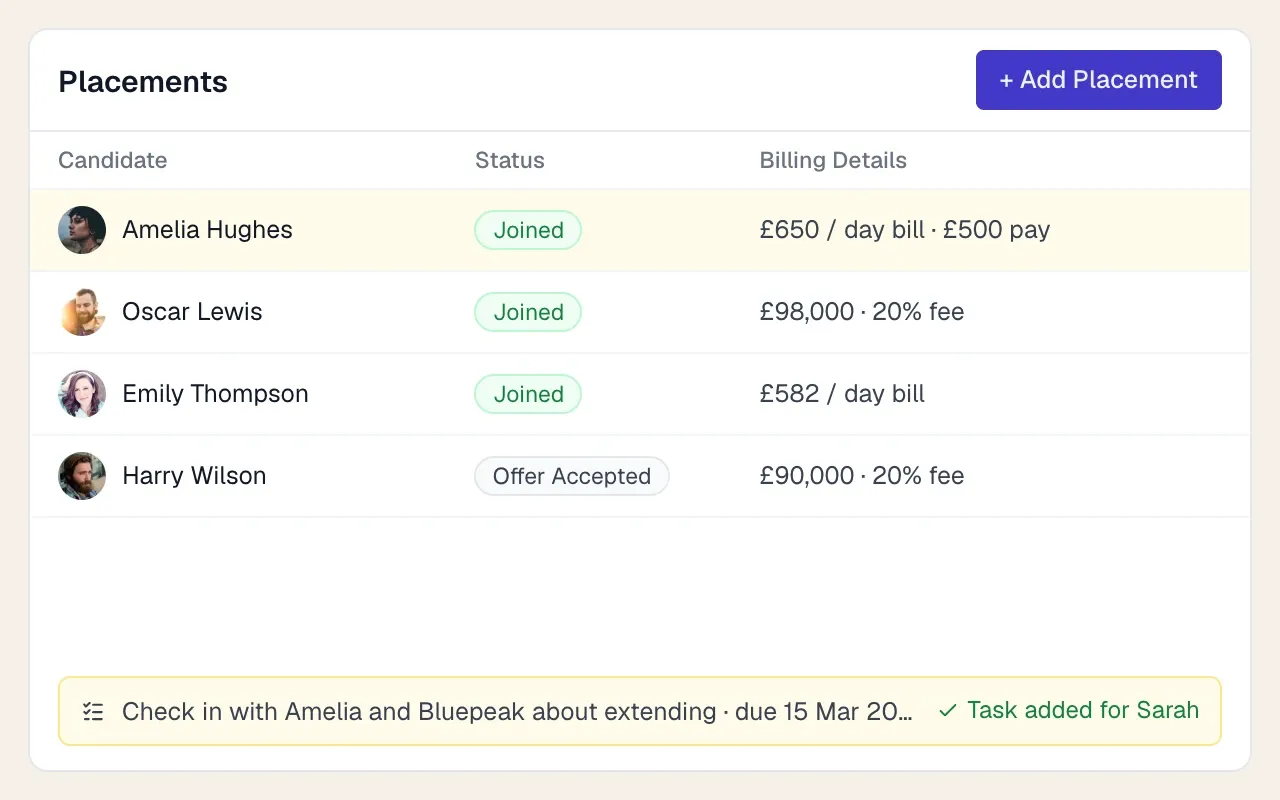
In Longlist, contract placements record exactly those rate details, and placements, tasks and campaign lists cover the reminders and redeployment. You can use it alongside Deel, Remote or an umbrella. Confirm whether the handoff uses manual entry, a CSV or a supported integration before buying: the provider pays the contractor, and Longlist keeps the relationship, so the contractor is on your shortlist again before the assignment ends.
Contract recruitment software for agencies
Run contract jobs, record bill and pay rates on every placement, and redeploy contractors before their assignments end.
Hours and invoices are the other half of contract operations; our timesheet software guide covers the weekly approval-to-pay cycle. For staffing firms deciding how much of the back office to own, see recruitment software for mid-sized US staffing firms and our staffing agency software page, and for UK agencies, recruitment software for large UK agencies and our page on recruitment software for the UK. The recruitment tech stack guide shows where each of these tools sits.