For a small agency, a useful starting mix is a careers page for every vacancy, a broad board for reach and a niche board for specialist roles. Search your own database before spending, then judge paid channels by qualified applicants and placements. Vendor terms were checked on October 16, 2026; confirm your agency’s eligibility before buying.
Job board source-quality tracker (CSV)A blank tracker with columns for spend, applicants, qualified, CVs sent, interviews, placements and the two cost-per ratios. Two fictional example rows show the arithmetic.DownloadA sensible starting mix for a small agency
Start with this mix, then adjust it using results from your own roles:
- Every job: your careers page with JobPosting markup, plus a search of your own database.
- Hourly and volume roles: sponsored Indeed with a modest per-job budget, raised only for jobs that are hard to fill.
- Professional roles: LinkedIn (promoted or a job slot) and one niche board for your specialism.
- Senior roles: direct sourcing first. Use the ad as a backstop and a signal to the market, and follow our executive search workflow for the real work.
- Review: once a quarter, using cost per qualified applicant and cost per placement.
If you’re still building the rest of the stack, our guides to recruitment agency software and what recruitment software costs a small agency cover the tools that sit behind the job ads.
How agencies should choose a board
Ask where candidates for this role look for work and whether they are actively looking.
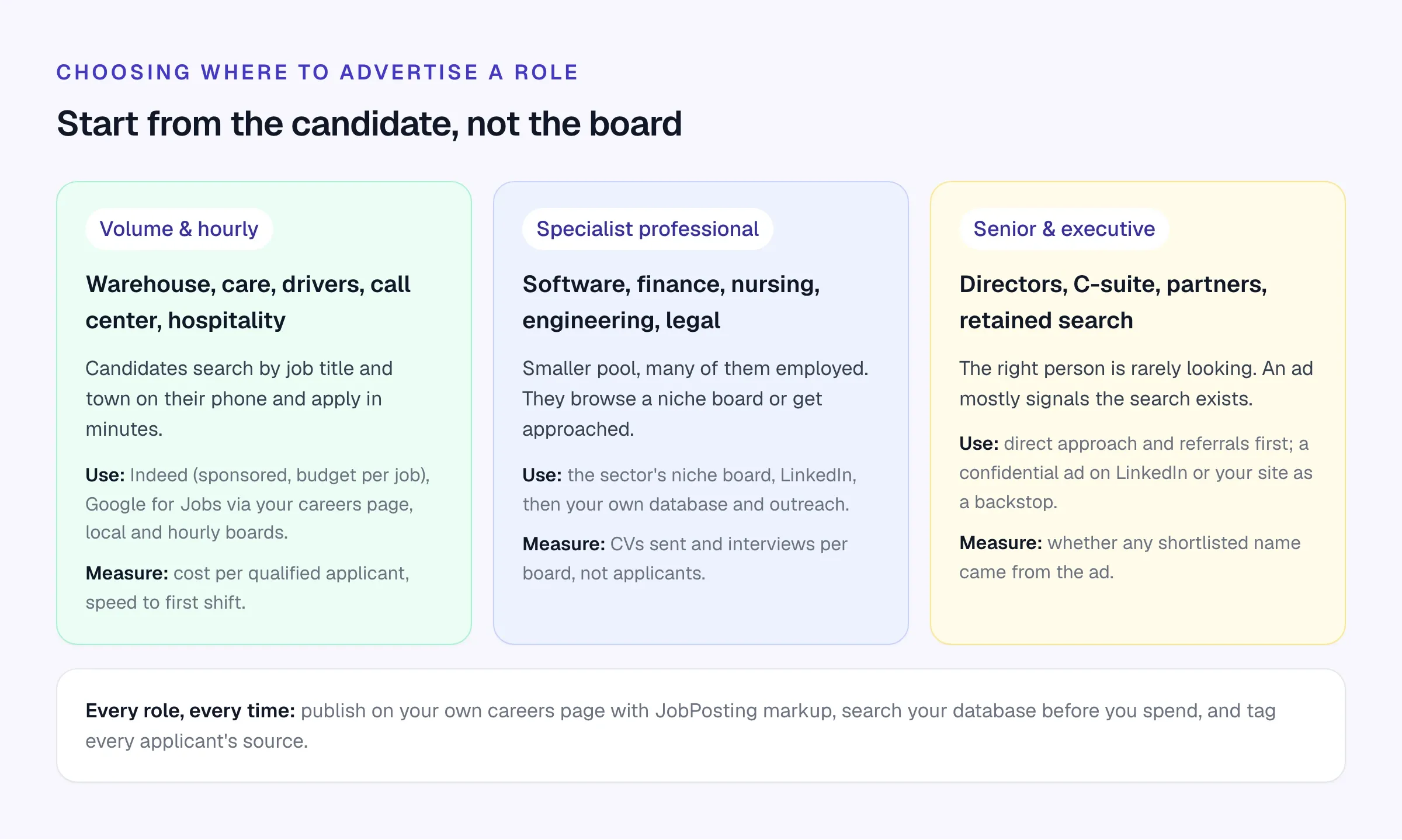
Three questions settle most decisions:
- Is the candidate actively looking? Job boards can reach warehouse operatives, care workers and bookkeepers between contracts. A senior executive who is settled in a role may need a direct approach. For passive markets, an ad is a supplement to candidate sourcing, not a replacement.
- How many qualified people exist within commuting distance? If the answer is thousands, a general board’s reach matters. If it is forty, a niche board or a Boolean search on LinkedIn will find more of them than a sponsored ad.
- What is the job worth to you? Work backward from the fee. A $4,000 temp-to-perm fee can’t carry a $1,500 ad campaign. A $30,000 retained search fee can carry almost anything, but the ad probably isn’t where the placement comes from.
General job boards: what each is good for in 2026
Indeed
Website ↗- Best for
- Hourly, volume and mid-level roles in most US and UK cities
- Pricing
- Sponsored jobs only for agencies; pay per click or per started application
A broad audience makes the ad’s wording important: a vague title or missing pay range can bring applications that do not fit the role.
What changed: Indeed now caps free posts at three a month for direct employers, live for up to 30 days (Indeed pricing guide, updated September 2026). Indeed told ERE in June 2026 that organic visibility for free jobs “is not guaranteed nor will it be consistent over time” and that it will limit refresh reposts (ERE, June 2026).
For agencies specifically: Indeed’s third-party recruiter policy says staffing, recruitment and placement companies may post jobs if they sponsor them, and that Indeed gives priority to jobs posted directly by employers. Budget for sponsorship on every job you put there.
How you pay: a budget you set per job, charged per click or per started application depending on your account and market. Indeed shows a recommended budget for the title and location, but you don’t have to follow it. CV search is sold separately as Smart Sourcing.
Write Indeed ads for a phone screen. Put pay, shift pattern and location in the first two lines, add two or three knockout screening questions, and close the job the day it is filled. A ghost job keeps costing you applicants you have to reject.
LinkedIn Jobs
Website ↗- Best for
- Professional, technical and white-collar roles; employer-branded searches
- Pricing
- Promoted jobs on a daily or total budget; job slots for agencies
The default for professional roles, and the place your candidates will check you out even if they apply elsewhere.
Free posts: one free job active at a time, active for up to 14 days, with an application limit that typically runs from 10 to 30 (LinkedIn Help). That is a sampling tool, not a campaign.
For agencies specifically: LinkedIn says “generic and staffing companies can’t post a free job with a Recruiter Lite account” (LinkedIn Help). Plan on promoted jobs or prepaid job slots.
Sourcing: Recruiter Lite includes 30 InMails a month. LinkedIn’s AI Hiring Assistant became globally available in English in September 2025.
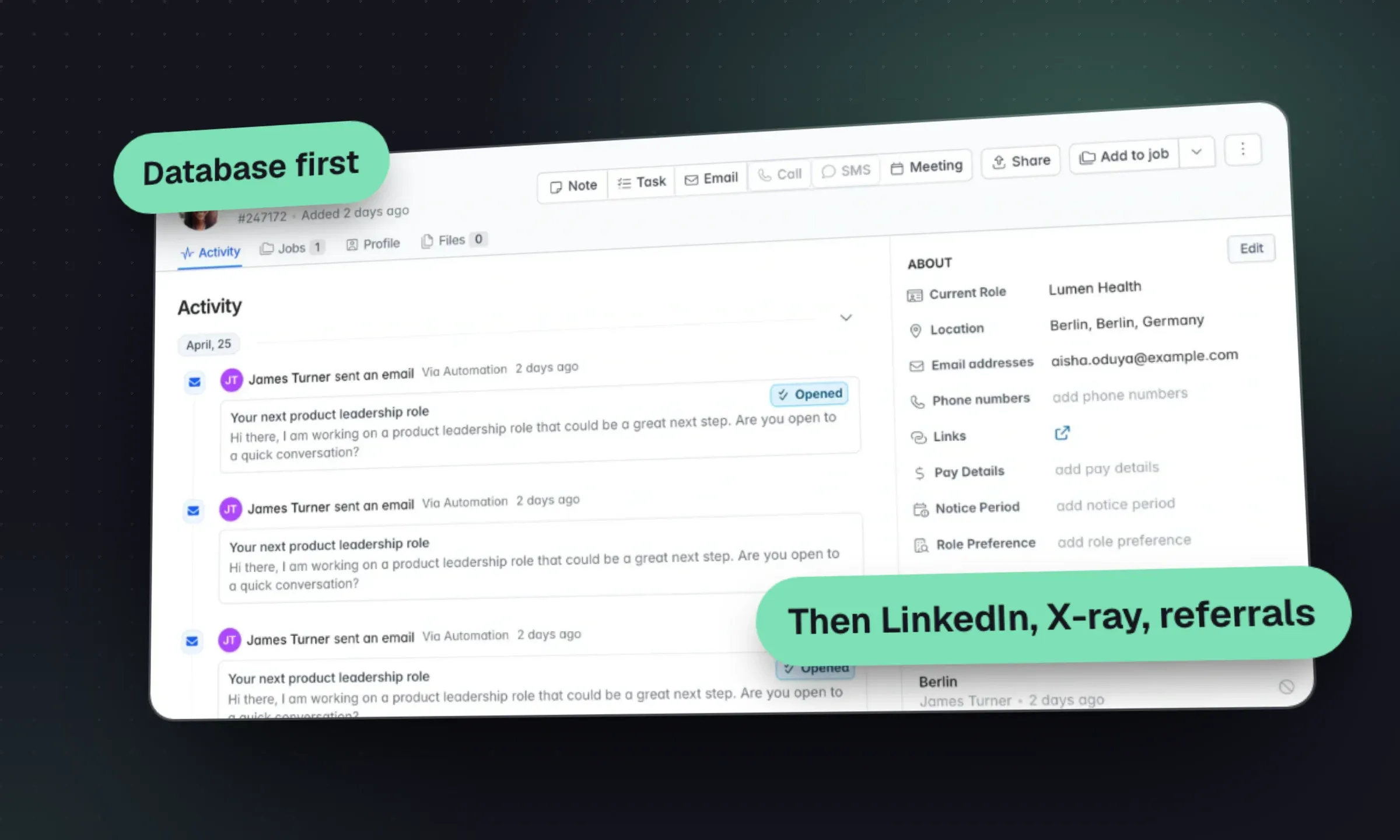
LinkedIn applicants skew toward people who are already employed and browsing. Expect fewer applicants than Indeed for the same role and a higher share worth a call. The bigger value for most agencies is still outreach, not ads; our recruitment email sequence templates cover the follow-up side.
Monster and CareerBuilder
Monster (with CareerBuilder)
Website ↗- Best for
- Budget US postings and resume search for generalist desks
- Pricing
- Monster+ Standard from $8/day; Monster+ Pro $299/month or $2,990/year (October 2026)
The merged CareerBuilder + Monster filed for Chapter 11 in June 2025, and the two job boards were sold to Bold, which kept both brands.
Monster’s employer site now says the two have “joined forces” and job postings are shared across both sites. Monster+ Standard is pay-per-click from $8 a day. Monster+ Pro is $299 a month or $2,990 a year and includes 299 monthly credits and resume search, with each resume view costing two credits (Monster pricing, checked October 2026).
Worth a test for generalist US roles if Indeed costs are climbing in your market. Older pricing quoted on other blogs, like $375 per post, is out of date.
ZipRecruiter
Website ↗- Best for
- US SMB-style roles where distribution to partner sites matters
ZipRecruiter posts to its own site and a network of partner boards, and pushes matched candidates to you. It is most useful for US roles where you want reach without managing several boards.
We couldn’t confirm ZipRecruiter’s current list prices from its own site in October 2026. Plans are subscription-based and shown when you start a posting, so compare the quote against your cost per placement from Indeed before committing.
Glassdoor
Website ↗- Best for
- Employer brand and reviews, not job distribution
Recruit Holdings announced in July 2025 that Glassdoor’s operations would fold into Indeed, and Glassdoor merged into Indeed Inc. on July 1, 2026. The site and brand continue. Glassdoor’s employer page now reads “Grow your employer brand with Glassdoor. Hire with Indeed.”
For agencies, Glassdoor matters mostly because candidates read your agency’s reviews before they reply. Job distribution happens through Indeed.
Boards to drop from your list
Some names on 2023-era roundups don’t belong on a 2026 shortlist:
- Hired. hired.com now redirects to LHH. The reverse-marketplace model it pioneered for tech hiring is gone from that site.
- Otta. It became Welcome to the Jungle, and otta.com redirects there. Treat it as a tech and startup board under the new name.
- SimplyHired, Ladders and Scouted as “must-haves”. We couldn’t confirm their current employer offers from their own sites in October 2026. Test them only if your own data says they work for your roles.
- Wellfound (formerly AngelList Talent) for client roles. Posting is free and unlimited, but Wellfound’s terms bar third-party recruiters and agencies from using the site. Fine for hiring your own staff, not for client jobs.
Niche job boards by sector
Niche boards win on qualified-applicant rate. A specialist board with forty applicants, fifteen of them worth a call, is a better week than three hundred applicants and forty worth a call, once you count the screening hours.
Dice
Website ↗- Best for
- US tech and IT contract desks
- Pricing
- $399 per single job slot (30 days); Starter $649/month month-to-month or $549/month on an annual contract (October 2026)
Dice has a dedicated staffing and recruiting offer, integrates with Bullhorn, and its Starter plan bundles three job slots with 250 candidate views a month (Dice pricing). For contract IT desks, the candidate database is often worth more than the ads.
Handshake
Website ↗- Best for
- Graduate and early-career roles in the US
- Pricing
- Basic free; promoted jobs from $34/day; Pro $450/month
The default channel to US college students and recent graduates. Check eligibility for third-party recruiters with your target schools, since many career centers set their own rules for agencies.
For other specialisms, these boards were live and taking employer listings in October 2026. Confirm agency eligibility and current rates directly before you buy, because niche boards change packages often and rarely publish prices.
Scroll the table to see all columns →
| Sector | Boards to test | What to check |
|---|---|---|
| Tech and product | Dice, Built In, Welcome to the Jungle | Whether agency posts are labeled; contract vs perm audience |
| Finance and accounting | eFinancialCareers | Region coverage; CV database access |
| Nursing and healthcare | Vivian Health, Health eCareers | Travel vs permanent audience; licensing filters |
| Hospitality | Poached, Hcareers | Local reach in your metro |
| Transport and logistics | CDLjobs.com | License class and route-type filters |
| Executive | ExecThread | Whether it is open to search firms; confidentiality |
| Nonprofit | Idealist | Pricing for agencies vs nonprofits |
| Creative and design | Authentic Jobs | Freelance vs full-time mix |
| Remote roles | Remote OK | Location restrictions in the ad |
| Local hourly | Craigslist | US job posts cost $10 to $75 depending on the area |
Your own careers page and Google for Jobs
Google for Jobs isn’t a board you post to. Google reads JobPosting structured data on job pages and shows eligible listings in its job search panel, free, in the US, UK and dozens of other countries. Job boards get there because their pages carry that markup. Your own careers page can too.
That makes your careers page the one channel that works for every role at zero media cost. It also builds an asset: applicants come to your agency, not to a board that will sell them back to you next month.
The rules are strict. Google requires a title, description, date posted, hiring organization and location, wants expired jobs removed or marked expired, and doesn’t allow listings without a way to apply. The free job boards guide walks through the JobPosting fields and the mistakes that get listings dropped.
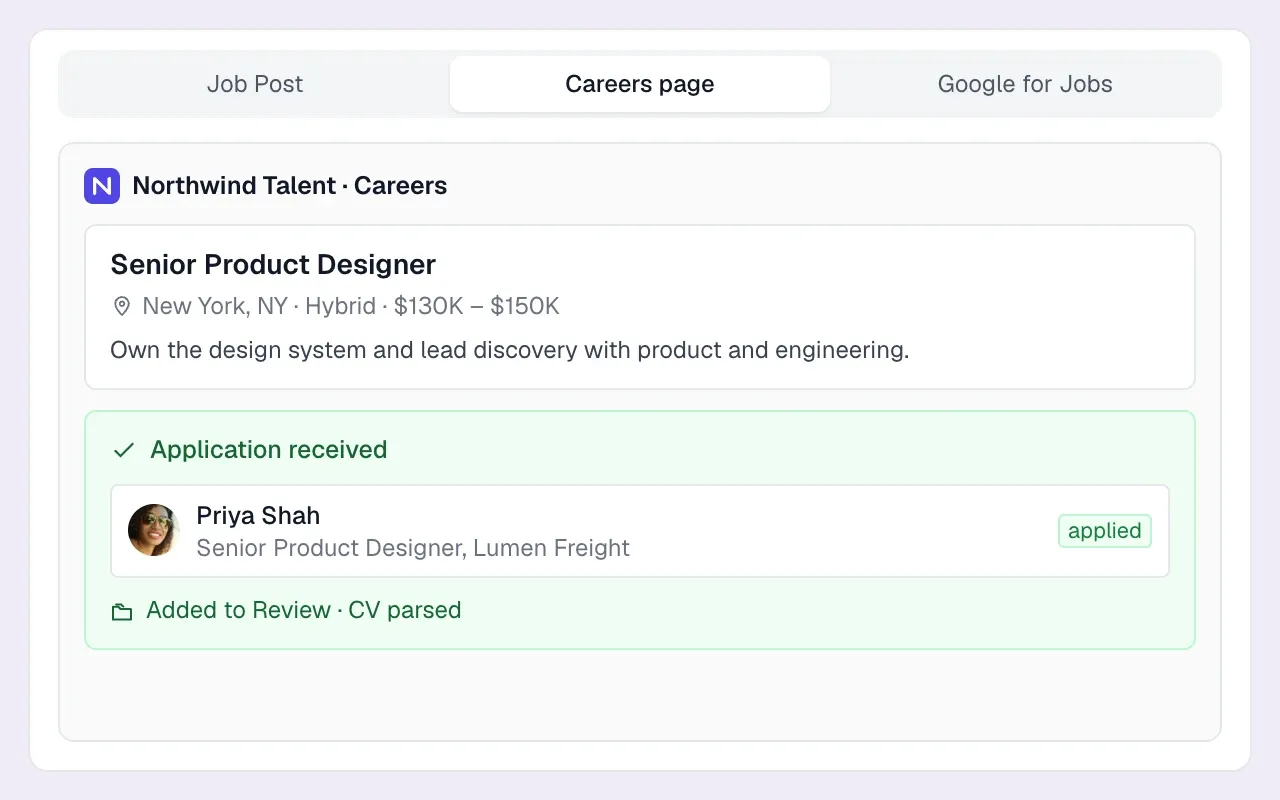
Longlist’s careers page publishes agency-branded job pages with JobPosting markup and a job sitemap, sends open roles to a Careerjet feed, and gives each job an apply-by-email address you can use in an Indeed listing so those applicants are parsed into the same pipeline. It pairs with direct posting or a multiposter for the paid boards you choose. Page views and applications are counted per job, and filled jobs drop off the listing automatically.
Your agency's job board, built in
Publish jobs on your own branded page, get them in front of Google for Jobs, and have every applicant’s CV parsed into the right job.
Multiposting: when it pays
A multiposter lets you write an ad once and push it to several boards, then pulls applicants back into one place. It earns its subscription when you post often to several paid boards. It doesn’t make a bad board good.
Scroll the table to see all columns →
| Tool | What it is | Notes (October 2026) |
|---|---|---|
| Broadbean | Multiposting and analytics | Owned by Veritone since 2023, bought from CareerBuilder (Veritone 10-K) |
| idibu | Multiposting | Used by agencies and staffing firms |
| LogicMelon | Multiposting | UK-based (Logic Enterprises Ltd) |
| eQuest | Job distribution | Long-running distribution service |
| Appcast and Joveo | Programmatic job advertising | Bid across many sites to a cost-per-applicant target; Appcast is part of the Stepstone Group |
Post by hand
- Fine under roughly five new jobs a week
- Forces you to choose boards deliberately
- No extra subscription
- Source tracking depends on your discipline
Use a multiposter
- Saves real hours above that volume
- Board-level applicant reports in one place
- Another contract and another login
- Easy to spray every job everywhere and inflate cost
Programmatic tools are a different animal. They move budget between sites automatically toward a cost-per-applicant goal. They make sense for high-volume staffing desks running dozens of identical roles, less so for a boutique placing one controller at a time.
Measure source quality, not applicant volume
Applicant totals alone do not tell you whether an advert paid off. A board can triple your applicants and leave placements flat, because the extra people are unqualified, already in your database, or applying to everything.
Appcast’s 2026 benchmark report, based on about 302 million clicks and 27 million applications across close to 1,200 US employers, found cost per application and cost per hire rose sharply in 2025 (HR Dive, February 2026). Rising prices make it more important to know which board is actually paying back.
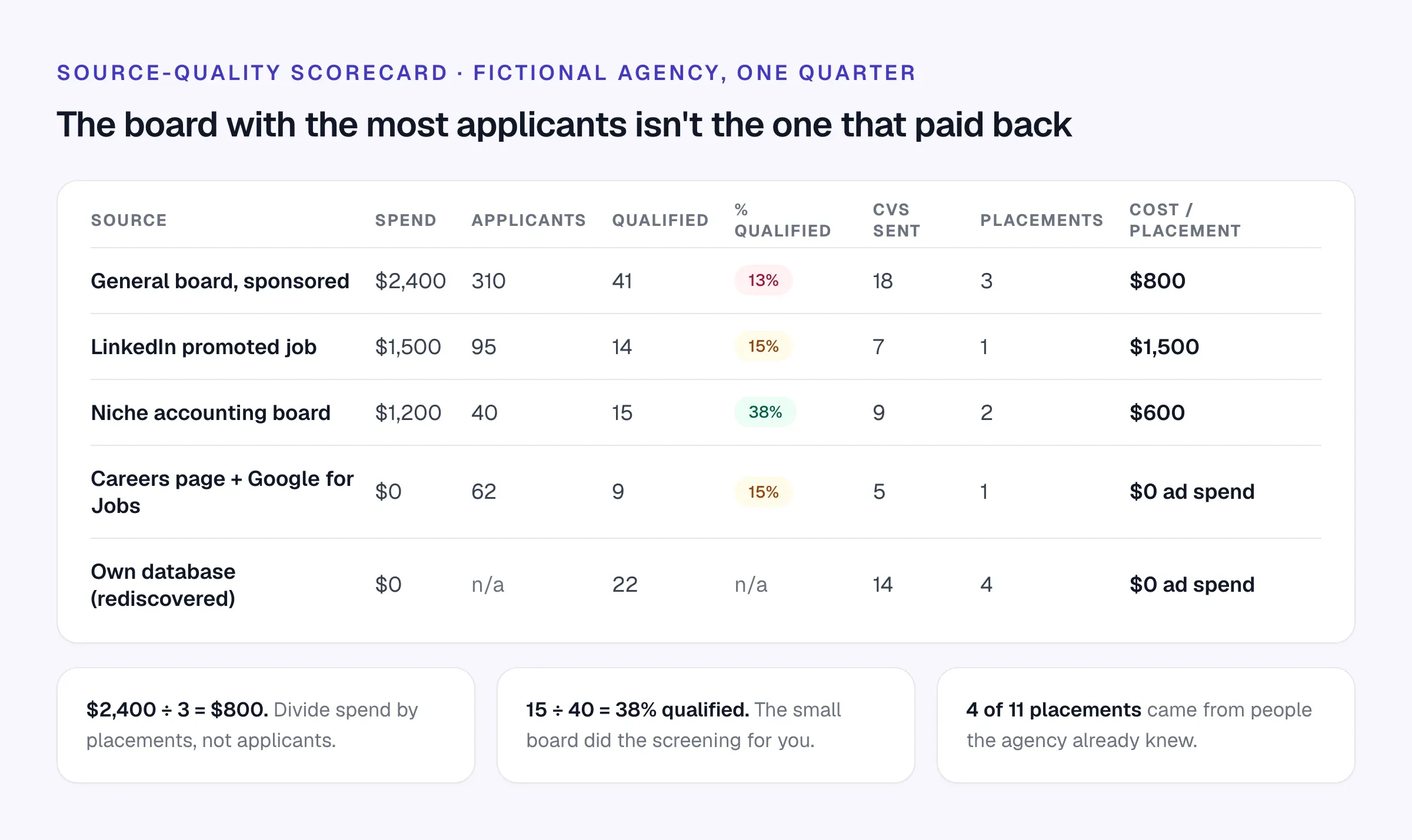
In the fictional quarter above, the general board produced 310 applicants and three placements: $2,400 ÷ 3 = $800 per placement. The niche board produced 40 applicants, but 15 were qualified (38%) and two were placed: $1,200 ÷ 2 = $600. The agency’s own database produced more placements than any paid board.
- Tag the source on every applicant. Use the same short list every time: the board name, “careers page”, “referral”, “database”, “outreach”. If a candidate says they saw the job on two sites, record where they applied.
- Record qualified, not just applied. Mark who passed your phone screen. That is the number that tells you about the board’s audience.
- Follow through to CVs sent and placements. Use the same stage definitions you use in your weekly KPI scorecard.
- Add spend per board per month. Include multiposter and job slot costs, split across the jobs they covered.
- Review quarterly, then cut. Pause the weakest board for comparable roles and check whether placements fall before removing it from the budget.
In Longlist, tags on the candidate record and recruitment reports on CVs sent, interviews and offers give you most of this without a spreadsheet, because every applicant, CV sent and placement sits on the same record.